
HMS Porpoise
1913 Acasta-class destroyer
Vessel Wikidata
* This information from Wikidata is available under the Creative Commons Attribution-ShareAlike License
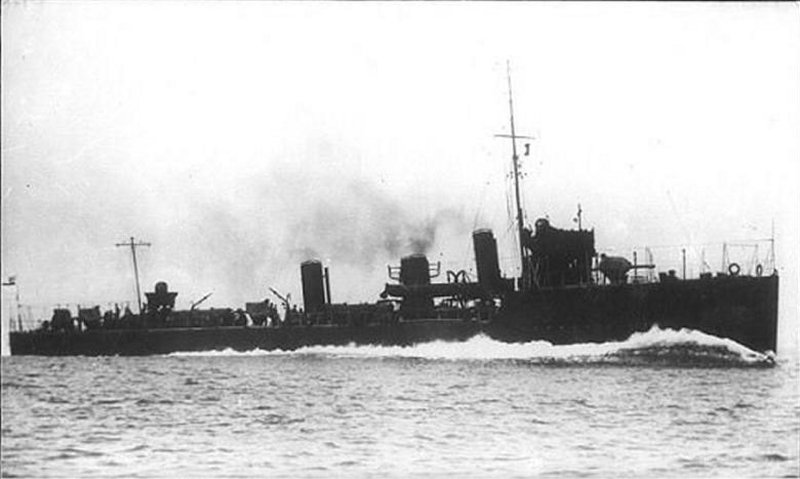
HMS Porpoise was an Acasta-class destroyer built by Thornycroft of Southampton between 1912 and 1914, measuring 265 feet 3 inches in overall length and 257 feet between perpendiculars. She had a beam of 29 feet 6 inches and a draught of 9 feet 3 inches, with a displacement of approximately 928 long tons. Her propulsion system consisted of four Yarrow boilers feeding Parsons steam turbines rated at 22,500 shaft horsepower, enabling her to reach a design speed of 31 knots. The vessel's crew comprised 73 officers and ratings. Armament included three 4-inch QF Mark IV guns, with 120 rounds per gun, and two 21-inch torpedo tubes with two reloads. During the First World War, she was fitted with a 2-pounder "pom-pom" autocannon for anti-aircraft defense. In 1918, her torpedo tubes and possibly one of her guns were removed to allow for a heavy depth charge complement, reflecting her evolving role in anti-submarine warfare. Launched on 21 July 1913 and completed in January 1914, Porpoise initially joined the 4th Destroyer Flotilla based at Portsmouth. She participated in significant wartime actions, including the Battle of Jutland in 1916, where she was part of the Grand Fleet support. During the battle, she sustained damage from German shells, which struck near her bridge and at the base of her aft funnel, damaging her steering and severing her main steam main. Despite these damages, she managed to reach the River Tyne for repairs. Throughout the war, she was active in operations including anti-submarine patrols, convoy escort duties, and engagements with German U-boats and torpedo boats, notably participating in the efforts that led to the sinking of the German light cruiser Elbing and the attempted ram of U-63. After the war, in 1920, she was sold to the Brazilian Navy, renamed Alexandrino de Alencar, and later Maranhão in 1927. In Brazilian service, she was modified with a different armament and participated in various activities, including attempts to suppress the Revolution of 1930 and the communist uprising in 1935. During World War II, Maranhão was used for patrol and convoy duties, fitted with sonar, depth charges, and additional anti-aircraft armament, until her decommissioning in 1946. Her service exemplifies the typical versatility and extended operational life of early 20th-century destroyers.
This description has been generated using GPT-4.1-NANO based on the Vessel's wikidata information and then modified by ShipIndex.org staff.