
HMS Agincourt
1913 dreadnought battleship
Vessel Wikidata
* This information from Wikidata is available under the Creative Commons Attribution-ShareAlike License
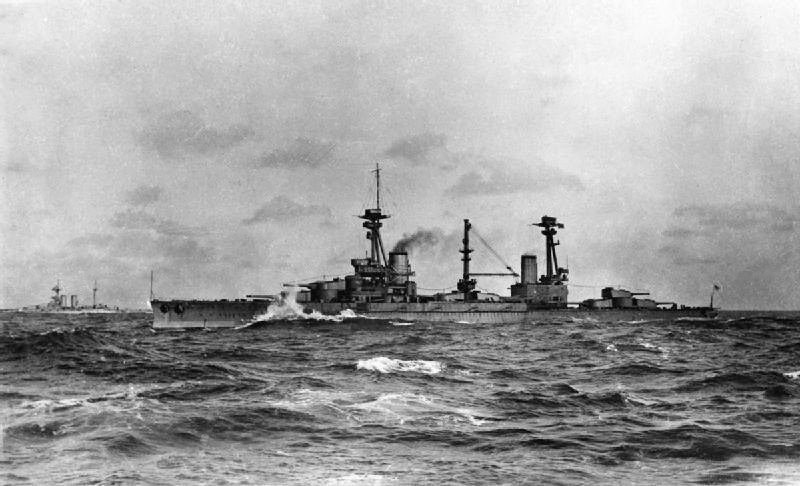
HMS Agincourt was a notable dreadnought battleship constructed in the United Kingdom during the early 1910s, originally ordered by Brazil as Rio de Janeiro. She was designed to be an impressive and heavily armed vessel, mounting a total of fourteen 12-inch guns—more than any other dreadnought—and featuring seven twin turrets, reflecting Brazil's desire for a formidable naval presence in the context of regional naval competition. Constructed by Armstrong Whitworth at their Elswick Yard, her keel was laid on 14 September 1911, and she was launched on 22 January 1913. Agincourt's dimensions included an overall length of approximately 671.5 feet (204.7 meters), a beam of 89 feet (27 meters), and a deep load displacement of about 27,850 long tons (28,297 tonnes). Her propulsion system comprised four Parsons steam turbines delivering over 40,000 shaft horsepower, which enabled her to reach speeds of around 22 knots. Her steam was generated by twenty-two Babcock & Wilcox water-tube boilers, capable of steaming for up to 7,000 nautical miles at 10 knots. Her main armament consisted of fourteen BL 12-inch Mk XIII guns in seven twin turrets, with a maximum elevation of 13.5 degrees initially, later increased to 16°, providing a range of roughly 20,000 yards. Her secondary armament included eighteen 6-inch guns and ten quick-firing 3-inch guns for close-range defense, along with three submerged 21-inch torpedo tubes. The ship’s armor protection was relatively modest compared to her armament, with a 9-inch waterline belt and turret armor of 12 inches, but her barbettes and other areas had less extensive protection, creating vulnerabilities. Originally built for Brazil, her construction was halted when the Brazilian government faced economic downturns and regional tensions. Before completion, she was sold to the Ottoman Empire and renamed Sultan Osman I. However, the outbreak of World War I led Britain to seize her in 1914, and she was commissioned into the Royal Navy as HMS Agincourt. During her service in the Grand Fleet, she participated in the Battle of Jutland in 1916, where she fired over 144 shells from her main guns, although she did not hit any targets. Post-war, Agincourt was placed in reserve and later considered for conversion into a mobile naval base, but the plans were canceled after the signing of the Washington Naval Treaty. She was sold for scrap in 1923 and dismantled by 1925, marking the end of her brief but notable service history. Her unique armament and international provenance make her a distinctive vessel in early 20th-century naval history.
This description has been generated using GPT-4.1-NANO based on the Vessel's wikidata information and then modified by ShipIndex.org staff.