
HMCS Prince Robert
Canadian merchant ship and armed cruiser
Vessel Wikidata
* This information from Wikidata is available under the Creative Commons Attribution-ShareAlike License
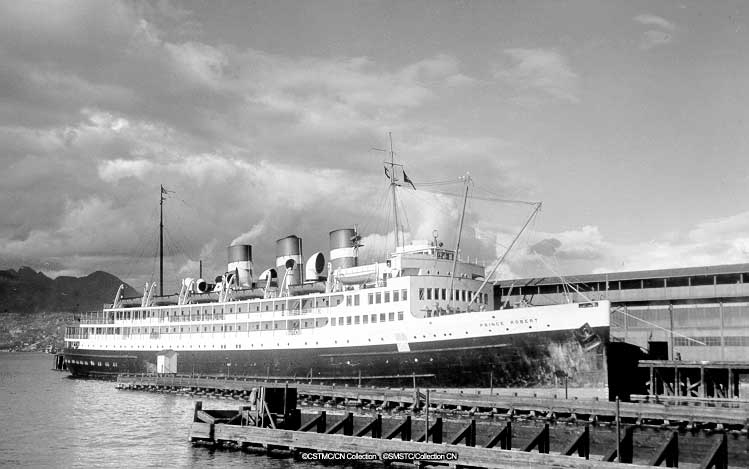
HMCS Prince Robert was a notable Canadian naval vessel originally constructed as a luxury passenger and cargo ship in the 1930s. Built by Cammell Laird at Birkenhead, it was the last of three ships designed for Canadian National, measuring approximately 385 feet in length with a beam of 57 feet and a depth of 20 feet 2 inches. Displacing about 5,579 tonnes and with a gross register tonnage of 6,893, the vessel was powered by twin Parsons turbines rated at 19,300 indicated horsepower, enabling it to reach speeds of over 22 knots. Its design featured refrigerated cargo holds, accommodation for 334 first-class and 70 third-class passengers, and a passenger capacity of up to 1,500 on day trips. The ship’s open bridge, three funnels, and six lifeboats characterized its appearance, though it suffered from design limitations such as poor maneuverability and excessive wash. Initially intended for luxury cruises along the British Columbia coast and later extended cruises to destinations such as Bermuda, South America, and Hawaii, the vessel faced operational challenges during the Great Depression, which contributed to its financial struggles. After its launch in 1930 and brief service interruptions, it was laid up for periods but resumed service in 1935, operating on the Vancouver–Alaska route. In 1939, it was selected as a royal yacht for King George VI and Queen Elizabeth’s visit to British Columbia. With the outbreak of World War II, the Royal Canadian Navy acquired Prince Robert, converting it into an armed merchant cruiser at Esquimalt starting in 1940. Armed with four 6-inch guns, anti-aircraft artillery, and depth charges, it became one of the most powerful ships in the Canadian fleet until larger cruisers arrived. Its notable wartime service included capturing the German freighter Weser off Mexico, patrolling the Pacific coast, escorting troop convoys, and supporting operations in the Atlantic, Mediterranean, and Pacific theaters. In 1943, it was converted into an anti-aircraft cruiser, mounting ten 4-inch dual-purpose guns and numerous smaller AA weapons, making it a formidable escort vessel. Prince Robert’s postwar career saw its sale into civilian service, where it was renamed Charlton Sovereign and later Lucania, serving as a passenger and refugee transport across Europe, South America, and the Caribbean until 1962. Its varied history underscores its significance as a versatile vessel that transitioned from luxury liner to military asset and finally to civilian transport, reflecting the evolving maritime needs of Canada and international refugee efforts during and after WWII.
This description has been generated using GPT-4.1-NANO based on the Vessel's wikidata information and then modified by ShipIndex.org staff.