
SS Haverford
transatlantic liner
Vessel Wikidata
* This information from Wikidata is available under the Creative Commons Attribution-ShareAlike License
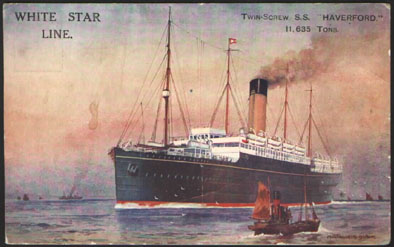
The SS Haverford was a British transatlantic ocean liner built in 1901 by John Brown & Company of Clydebank, Scotland. Designed primarily for transporting migrants and cargo, she was a medium-sized vessel with a gross register tonnage of 11,635 GRT and a net register tonnage of 7,493 NRT. She measured 531 feet (161.8 meters) in length and 59.2 feet (18.0 meters) in beam. The ship was powered by triple-expansion engines, which enabled her to reach an average speed of 14 knots, a modest pace reflecting her intended role of carrying large numbers of emigrants—initially accommodating 1,700 third-class passengers and 150 second-class passengers, later adjusted to carry 1,308 third-class and 216 second-class travelers. Her hull was divided into eleven watertight compartments, with seven holds designed to carry cargo. The vessel featured a distinctive profile with a single funnel and four masts along her centerline. Her construction was funded by Clement Griscom, director of the International Navigation Company, and she was launched on 4 May 1901, completing her fitting by August of that year. Her maiden voyage was experimental from Southampton to New York via Cherbourg, after which she was briefly loaned to the Red Star Line for service between Antwerp and New York. She was part of the American Line’s fleet, serving routes from Southampton to New York and later from Liverpool to Philadelphia, often within the fleet of the International Mercantile Marine Co. (IMM), which also operated her sister ship, Merion. Haverford’s service was marked by notable incidents, including a deadly explosion in 1906 at Liverpool docks caused by Fels-Naptha soap fumes, which resulted in 13 fatalities. During World War I, she was requisitioned as a troop transport in January 1915, serving initially in the Dardanelles before returning to Atlantic duties. She was torpedoed by German U-boat U-94 in June 1917, suffering significant damage but was beached and repaired. After surviving additional attacks and repatriating American troops post-war, she resumed civilian service in 1919, maintaining her route to Philadelphia. In the early 1920s, she changed hands within IMM’s fleet, serving under White Star Line, which retained her original name—a departure from typical naming conventions. Her later years saw structural and electrical issues, leading to her withdrawal from service in 1924. The vessel was sold for scrap in December 1924 and dismantled in Italy in 1925, marking the end of her maritime career.
This description has been generated using GPT-4.1-NANO based on the Vessel's wikidata information and then modified by ShipIndex.org staff.