
HMS Ark Royal
1937 aircraft carrier
Vessel Wikidata
* This information from Wikidata is available under the Creative Commons Attribution-ShareAlike License
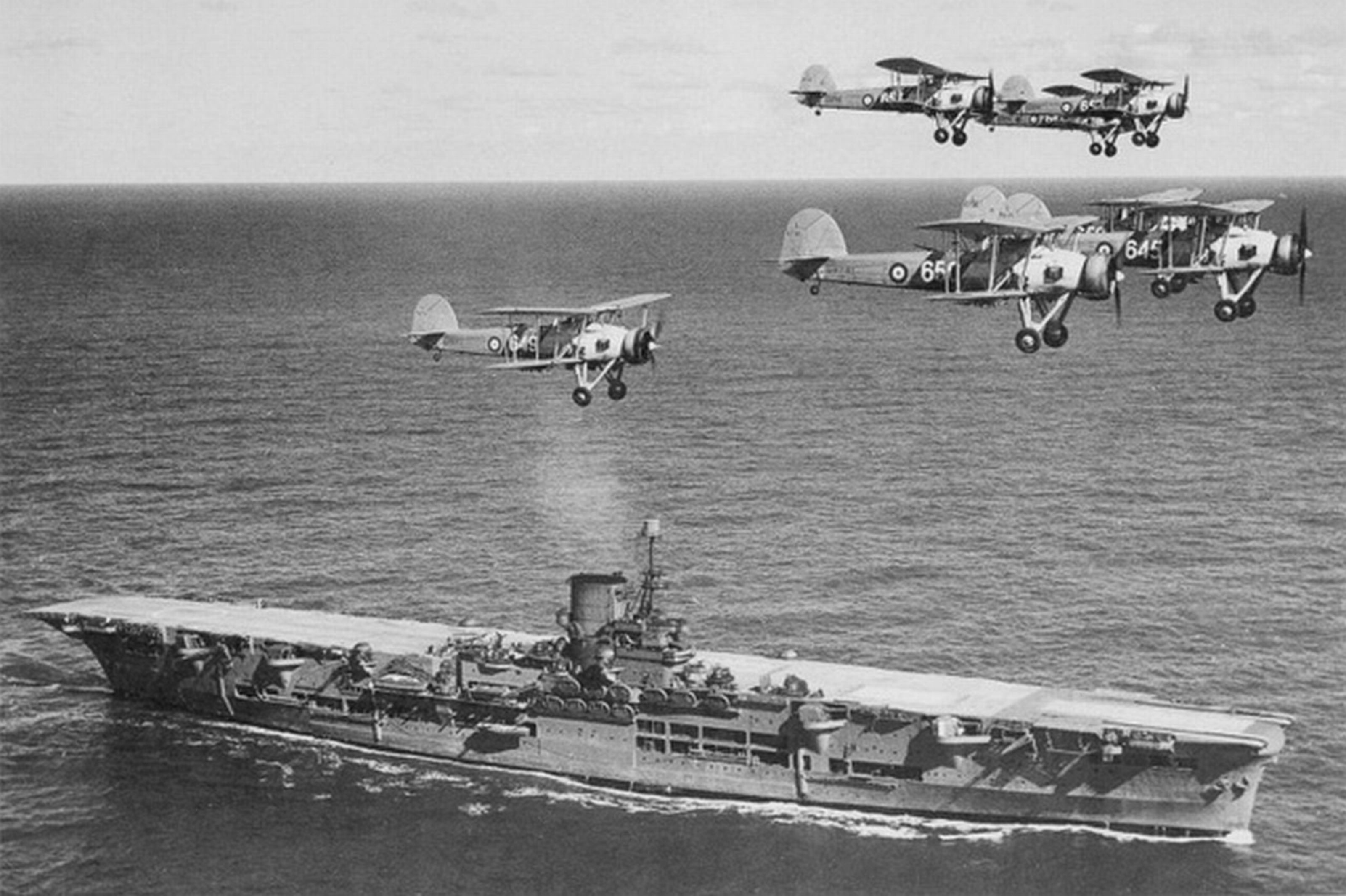
HMS Ark Royal (pennant number 91) was a notable aircraft carrier of the Royal Navy, completed in November 1938 and built by Cammell Laird in Birkenhead, England. Designed to meet the restrictions of the Washington Naval Treaty, Ark Royal featured an innovative integrated hull design where the hangars and flight deck were an integral part of the ship's structure, rather than add-ons. She was equipped with two enclosed hangar decks, capable of carrying up to 72 aircraft, although operationally she usually carried between 50 and 60 due to the development of larger aircraft. Her flight deck measured approximately 800 feet (240 meters) in length and rose 66 feet (20 meters) above the waterline, with the flight deck serving as the ship's "strength deck" and reinforced with 19mm Ducol steel plating for splinter protection. Ark Royal was powered by six boilers and three Parsons geared turbines, producing a maximum speed of over 31 knots (about 57.8 km/h), allowing rapid maneuvering during flight operations. Her main armament included sixteen 4.5-inch dual-purpose guns in eight twin turrets, with additional anti-aircraft weapons such as six 2-pounder pom-poms and machine guns. She could carry a complement of sixteen Fleet Air Arm squadrons, initially equipped with aircraft like Blackburn Skuas and Fairey Swordfish, evolving to Fulmars and other aircraft throughout her service. Operationally, Ark Royal played a significant role during WWII, participating in key engagements such as the hunt for the Bismarck, the Malta convoys, and operations in Norway. She was involved in the first aerial U-boat kills and provided crucial air support during the early years of the war. Despite her active service, she was torpedoed by U-81 on 13 November 1941 and sank the following day, with 44 crew members losing their lives. The sinking resulted from design flaws, particularly inadequate damage control and power redundancy, which were later addressed in subsequent British carriers. The wreck was discovered in 2002 at a depth of about 3,300 feet (1,000 meters) near Gibraltar, lying in two main pieces with the stern upright and the bow upside down, providing valuable insights into wartime naval architecture and the hazards faced by aircraft carriers during the conflict.
This description has been generated using GPT-4.1-NANO based on the Vessel's wikidata information and then modified by ShipIndex.org staff.