
Petropavlovsk
1894 Petropavlovsk-class battleship
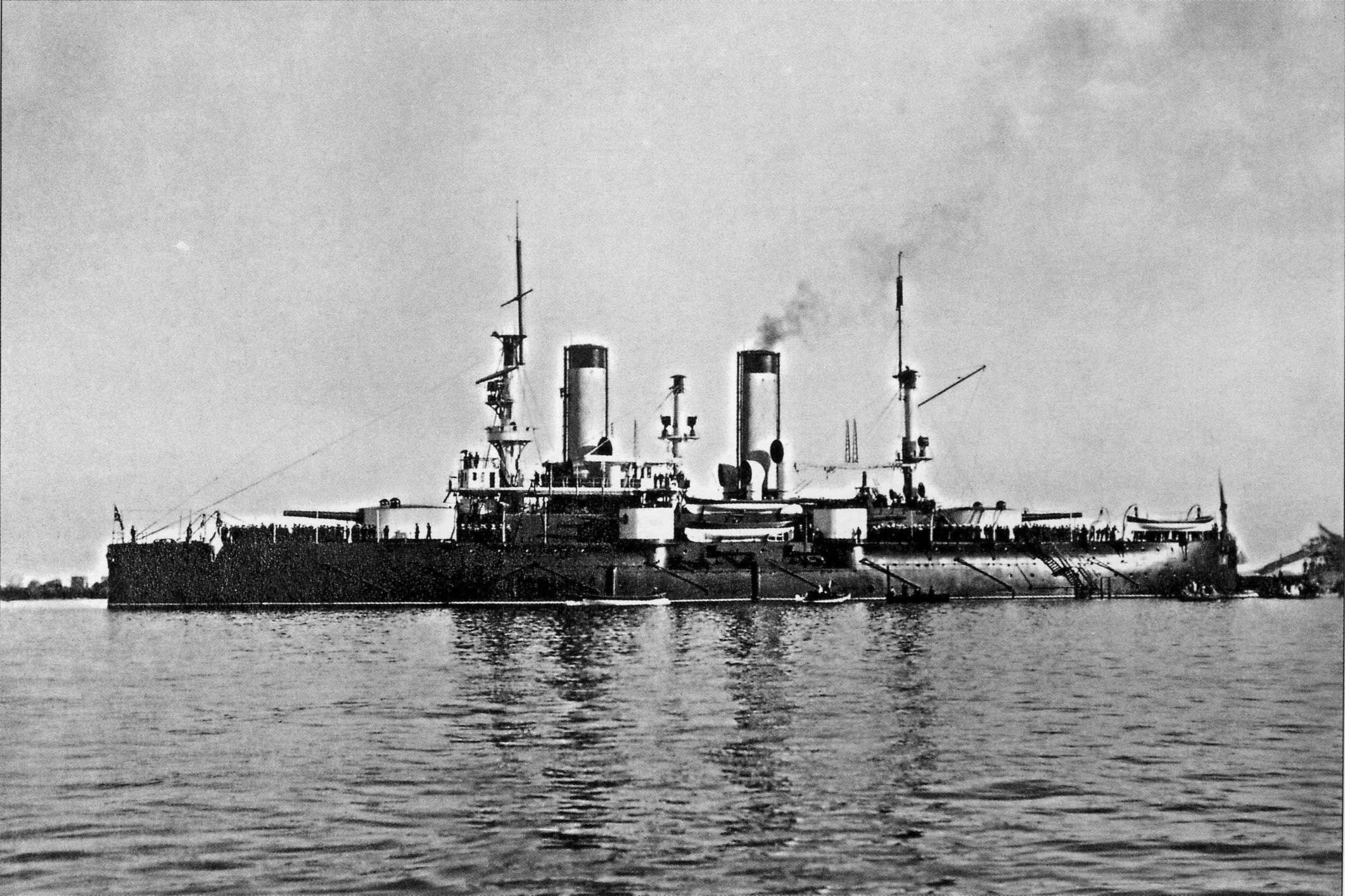
Vessel Wikidata
* This information from Wikidata is available under the Creative Commons Attribution-ShareAlike License
The Petropavlovsk was the lead ship of her class of three pre-dreadnought battleships built for the Imperial Russian Navy at the end of the 19th century. Laid down on May 19, 1892, at the Galernii Island Shipyard, she was launched on November 9, 1894, and completed after a protracted construction period that lasted six years due to shortages and design changes. She was named in honor of Russia’s successful defense during the 1854 Siege of Petropavlovsk. Constructed with a length overall of 376 feet (114.6 meters), a beam of 70 feet (21.3 meters), and a draft of 28 feet 3 inches (8.6 meters), the ship displaced approximately 11,354 long tons (11,536 tons) upon completion, slightly overweight from her designed displacement. Her armor featured a waterline belt ranging from 12 to 16 inches (305–406 mm) in thickness, with main gun turrets armored up to 10 inches (254 mm), and deck armor between 2 and 3 inches (51–76 mm). The armor was sourced from Bethlehem Steel due to domestic shortages. Power was provided by two British-built vertical triple-expansion steam engines, each driving a single shaft, with 14 cylindrical boilers generating 10,600 indicated horsepower. This propulsion system allowed her to reach a top speed of approximately 16.38 knots (30.34 km/h). She carried enough coal for a range of 3,750 nautical miles (6,940 km) at 10 knots. Her armament comprised four 12-inch (305 mm) guns in twin turrets, supplemented by twelve 6-inch (152 mm) quick-firing guns, smaller anti-torpedo boat guns, and six torpedo tubes—four above water and two submerged. She also carried 50 mines for harbor defense. The Petropavlovsk served as the flagship of the First Pacific Squadron upon her arrival in the Far East in 1900. Her service included participation in suppressing the Boxer Rebellion in 1900. During the Russo-Japanese War, she was involved in the Battle of Port Arthur in 1904, where she was lightly damaged but ultimately sank after striking mines on April 13, 1904, near Port Arthur, with the loss of 679 crew, including Vice Admiral Stepan Makarov. Her sinking marked a significant event in the naval campaign, and her wreck was later identified as the burial site of Makarov, commemorated by a monument in Saint Petersburg. The Petropavlovsk's design, armament, and service history highlight her importance as a key vessel in Russia’s pre-dreadnought fleet and her role in the conflicts of the early 20th century.
This description has been generated using GPT-4.1-NANO based on the Vessel's wikidata information and then modified by ShipIndex.org staff.