
HMS Dainty
1932 D-class destroyer
Vessel Wikidata
* This information from Wikidata is available under the Creative Commons Attribution-ShareAlike License
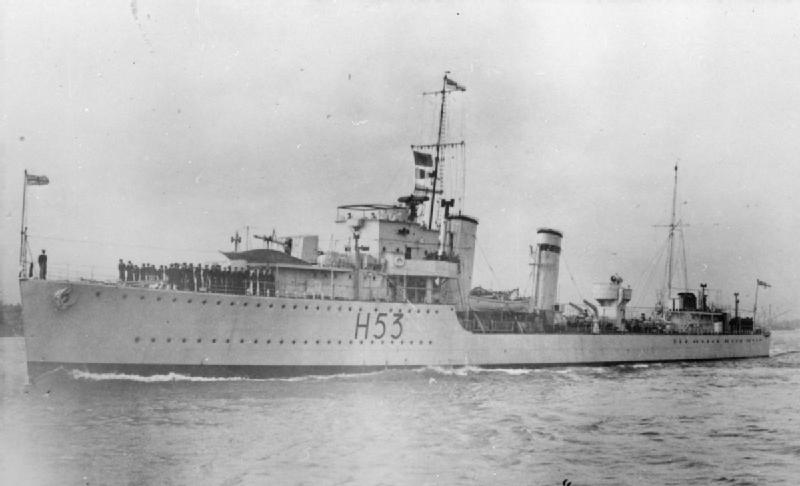
HMS Dainty was a D-class destroyer constructed for the Royal Navy in the early 1930s, featuring a displacement of approximately 1,375 long tons at standard load and up to 1,890 long tons at deep load. She measured 329 feet in length, with a beam of 33 feet and a draught of 12 feet 6 inches. Powered by Parsons geared steam turbines driving two shafts, Dainty could reach a maximum speed of 36 knots, with steam supplied by three Admiralty 3-drum water-tube boilers. Her fuel capacity of 473 long tons of oil allowed for a range of roughly 5,870 nautical miles at 15 knots. The ship's complement consisted of 145 officers and men. Armament included four 45-calibre QF 4.7-inch Mark IX guns in single mounts, supplemented by a single 12-pounder gun and two quadruple Mark I mounts for 0.5-inch Vickers machine guns for anti-aircraft defense. She was also equipped with two quadruple 21-inch torpedo tube mounts and carried depth charges—initially 20, later increased to 35—fitted with a depth charge rail and two throwers. Laid down on 20 April 1931 at Fairfield Shipbuilding and Engineering Company in Govan, Scotstoun, Dainty was launched on 3 May 1932 and completed by 22 December 1932 at a cost of £229,378. She was initially assigned to the Mediterranean Fleet's 1st Destroyer Flotilla, with deployments including the Persian Gulf, Red Sea, and China Station, where she conducted anti-piracy patrols and port visits. With the outbreak of World War II, Dainty transferred to the Mediterranean Fleet, participating in convoy escort, patrol, and combat operations. She notably took part in the Battle of Calabria in July 1940 and engaged in various anti-submarine actions, including damaging the Italian submarine Console Generale Liuzzi and sinking the Uebi Scebeli. On 24 February 1941, while on patrol near Tobruk with Hasty, Dainty was struck by a German bomb, which caused a catastrophic explosion and led to her sinking. Her service exemplifies the active role of British destroyers in the Mediterranean theater during the early years of the war, and her loss marked a significant event in naval engagements against Axis forces.
This description has been generated using GPT-4.1-NANO based on the Vessel's wikidata information and then modified by ShipIndex.org staff.