
HMS Indomitable
1907 Invincible-class battlecruiser
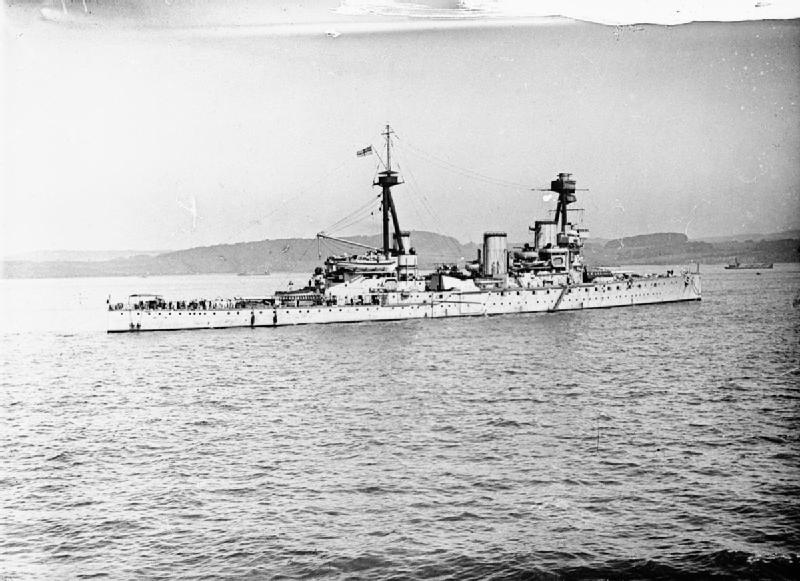
Vessel Wikidata
* This information from Wikidata is available under the Creative Commons Attribution-ShareAlike License
HMS Indomitable was an Invincible-class battlecruiser constructed for the Royal Navy, reflecting significant advancements over earlier armored cruisers. Built by Fairfield Shipbuilding & Engineering at Govan, she was laid down in March 1906, launched in March 1907, and commissioned in June 1908. Her overall length was 567 feet (172.8 meters), with a beam of approximately 78.75 feet (24 meters) and a deep load draft of 30 feet (9.1 meters). She displaced around 17,250 long tons (17,530 metric tons) at normal load, increasing to about 20,420 long tons (20,750 metric tons) at deep load, making her nearly 3,000 tons larger than her predecessors. Indomitable was powered by two paired Parsons direct-drive turbines, designed to produce 41,000 shaft horsepower but reaching nearly 48,000 shp during trials, enabling her to exceed her intended speed of 25 knots, achieving approximately 26.1 knots during tests. Her steam plant included 31 Babcock & Wilcox water-tube boilers, with a maximum coal bunkerage of over 3,000 tons and additional fuel oil for increased range, allowing her to steam over 3,000 nautical miles at 10 knots. Her armament comprised eight 12-inch (305 mm) Mk X guns in four twin turrets, and initially sixteen 4-inch (102 mm) secondary guns, later reduced and rearmed with twelve 4-inch BL MK VII guns by 1917. She also carried a modest anti-aircraft armament, including a 3-inch AA gun, a 3-pounder Hotchkiss gun, and a 4-inch AA gun added in 1917. Her torpedo armament consisted of five 18-inch submerged tubes, with fourteen torpedoes carried. Protection was provided by a waterline belt up to 6 inches thick amidships, with 7-inch armor on turrets and barbettes, and decks ranging from 1 to 2 inches thick. Additional armor was added after the Battle of Jutland to improve her vulnerability to plunging fire. Indomitable's service included early actions in the Mediterranean, pursuit of German ships, and participation in the Gallipoli attack in 1915. She played a notable role in the Battle of Dogger Bank in 1915, sinking the German armored cruiser Blücher and towing the damaged HMS Lion. During the Battle of Jutland in 1916, she damaged enemy battlecruisers Seydlitz and Derfflinger but was tragically sunk in just 90 seconds after a catastrophic magazine explosion, with most of her crew lost. Deemed obsolete after the war, she was sold for scrap in 1921, marking the end of her significant and active naval career.
This description has been generated using GPT-4.1-NANO based on the Vessel's wikidata information and then modified by ShipIndex.org staff.