
Herzogin Cecilie
four-masted barque
Vessel Wikidata
* This information from Wikidata is available under the Creative Commons Attribution-ShareAlike License
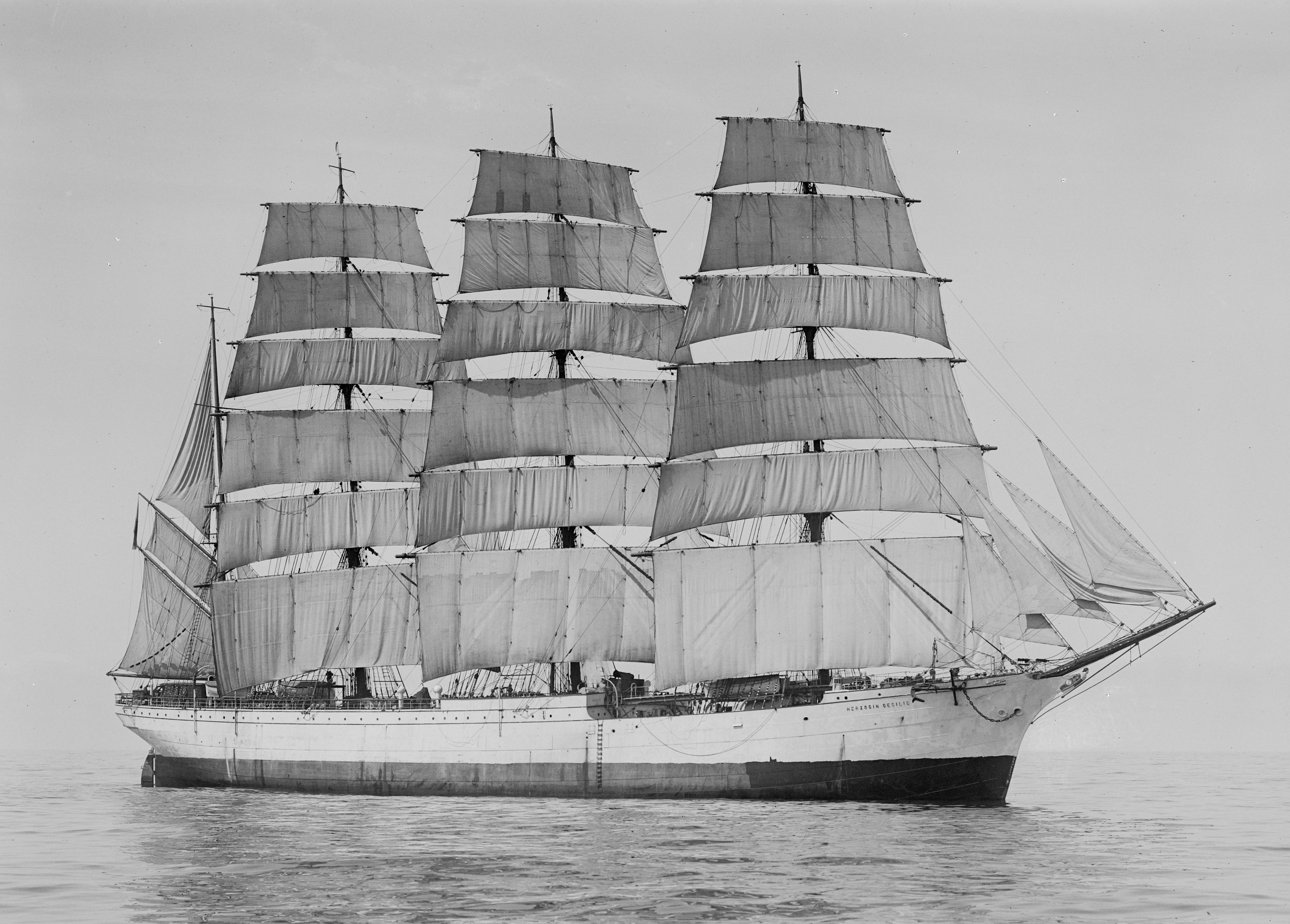
Herzogin Cecilie was a distinguished German four-mast barque built in 1902 by Rickmers Schiffbau AG in Bremerhaven, with yard number 122. She measured approximately 102.01 meters (334 feet 8 inches) in length, with a beam of 14.10 meters (46 feet 3 inches) and a draft of 7.37 meters (24 feet 2 inches). Notably, she was painted white, setting her apart from the typical black Flying-P-Liners or green ships of Rickmers. Designed for high performance, Herzogin Cecilie was among the fastest windjammers of her era, capable of reaching speeds up to 21 knots, and was particularly renowned for her speed on long trade routes. Her service history highlights her role in the Chilean nitrate trade and the Australian wheat trade, where her speed gave her a competitive advantage. She famously completed the trip around Cape Horn from Portland, Oregon, to The Lizard, England, in just 106 days in 1903. During World War I, she was interned in Chile and returned to Germany in 1920. Subsequently, she was transferred to France as reparation, and later sold to Finnish shipowner Gustaf Erikson, based in Mariehamn. In her later career, Herzogin Cecilie became prominent in the grain races, competing fiercely to deliver wheat from Australia to Europe. She achieved notable success, winning the grain race four times before 1921 and another four times between 1926 and 1936. Her voyages included a record-setting 86-day passage from Port Lincoln to Falmouth in 1935. Her final years were marked by a grounding on Ham Stone Rock in April 1936, after which she was towed and beached at Starhole Bay. She capsized and sank on 18 January 1939 at a depth of 7 meters. Today, remnants of Herzogin Cecilie remain at the site of her sinking. Salvaged parts, including her captain’s saloon, are preserved at the Åland Maritime Museum, serving as a testament to her maritime legacy. Her story is commemorated in folk songs and maritime history as one of the fastest and most notable windjammers of her time.
This description has been generated using GPT-4.1-NANO based on the Vessel's wikidata information and then modified by ShipIndex.org staff.