
HMS Courageous
1916 Courageous-class battlecruiser
.jpg)
Vessel Wikidata
* This information from Wikidata is available under the Creative Commons Attribution-ShareAlike License
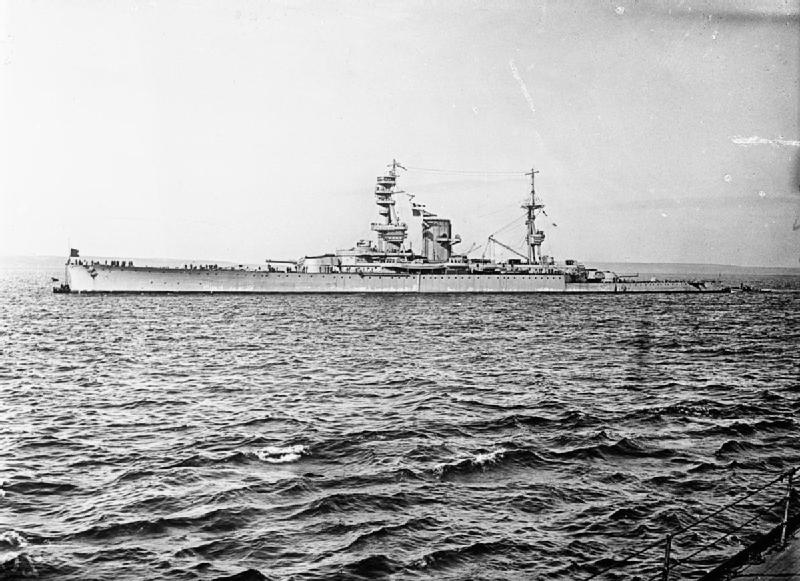
HMS Courageous was a lead ship of her class of battlecruisers built for the Royal Navy during World War I. She measured approximately 786 feet 9 inches (239.8 meters) in length, with a beam of 81 feet (24.7 meters) and a deep load draught of 25 feet 10 inches (7.9 meters). Displacing around 19,180 long tons (19,490 tonnes) at load and 22,560 long tons (22,922 tonnes) at deep load, she was a notably large vessel for her time. She was the first large warship in the Royal Navy to feature geared steam turbines, powered by eighteen Yarrow boilers, which produced a total of 90,000 shaft horsepower. This propulsion enabled HMS Courageous to reach an estimated top speed of 30.8 knots (57 km/h). Constructed by John Brown & Company, she was laid down on 26 March 1915, launched on 5 February 1916, and completed by 4 November 1916. Her armament comprised four 15-inch (381 mm) BL Mk I guns in two twin turrets, and eighteen 4-inch (102 mm) secondary guns. She also carried two submerged 21-inch (533 mm) torpedo tubes with ten torpedoes and was lightly armored, reflecting her design intent for speed and reconnaissance rather than heavy combat. During WWI, Courageous served in the Grand Fleet, participating notably in the Second Battle of Heligoland Bight in November 1917 and being present when the German High Seas Fleet surrendered in 1918. Post-war, she was decommissioned, laid up, and later converted into an aircraft carrier in the mid-1920s to comply with the Washington Naval Treaty. Her conversion involved removing her guns, superstructure, and fittings to accommodate a large hangar and flight deck, allowing her to carry up to 48 aircraft. She was reconstructed with an island atop the starboard side and equipped with catapults and anti-aircraft guns. Courageous served mainly off Great Britain and Ireland in her career as an aircraft carrier, participating in fleet operations and training. She was involved in the response to the Palestine riots in 1929 and saw various refits during her service. At the outbreak of WWII, she was serving with the Home Fleet, equipped with Swordfish torpedo bombers. Her maritime significance lies in her transition from a WWI battlecruiser to an early aircraft carrier, representing the evolution of naval warfare and carrier design in the interwar period. Her service ended tragically in September 1939 when she was torpedoed by the German U-boat U-29, sinking with the loss of over 500 crew members, marking the first British warship lost to enemy action in WWII.
This description has been generated using GPT-4.1-NANO based on the Vessel's wikidata information and then modified by ShipIndex.org staff.