
HMS Africa
1781 Inflexible-class third-rate ship of the line
.jpg)
Vessel Wikidata
* This information from Wikidata is available under the Creative Commons Attribution-ShareAlike License
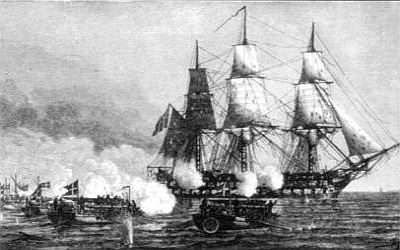
HMS Africa was a 64-gun third-rate ship of the line of the Royal Navy, launched on 11 April 1781 at Barnard's Thames Yard in Deptford. Designed by John Williams as part of the Inflexible-class, she was a smaller version of the 74-gun ships, influenced by earlier naval designs such as HMS Albion and HMS Neptune. Her dimensions included a length of approximately 160 feet 10 inches on the gun deck, a beam of 44 feet 9 inches, and a depth in the hold of 18 feet 1 inch, with a burthen of around 1,414 tons. Constructed under the contract approved in early 1778 and laid down in March 1778, Africa was completed and fitted out by July 1781. Initially, her sailing qualities were questioned, and as the lead ship of her class, her design was ultimately deprecated, leading to the decision not to build further ships of her class. She was commissioned in March 1781 under Captain Thomas Newnham and later transferred to Captain Robert McDowell in 1782, who took her to the East Indies. Africa participated in the Battle of Cuddalore in June 1783 during the American Revolutionary War. After returning to Britain and being paid off in 1784, she spent time in ordinary at Plymouth. She saw brief service in 1790 under Captain James Kempthorne and was recommissioned in 1793 for the French Revolutionary Wars. Her notable engagements include an attack on Léogâne in 1796, which was unsuccessful due to damage from shore batteries. Reconfigured as a 64-gun ship again in 1804-1805, Africa played a role at the Battle of Trafalgar in October 1805. Arriving after the main engagement and unfamiliar with Nelson’s plan, she proceeded to engage the enemy fleet, suffering casualties of 18 killed and 44 wounded. During the Gunboat War, she was involved in a notable action in the Baltic in 1808, where she fought Danish gunboats and sustained damage, but her convoy successfully reached Britain. Throughout her service, Africa was commanded by various officers, including George Frederick Ryves and John Houlton Marshall. She also participated in the pursuit of USS Constitution during the War of 1812 under Captain John Bastard. The ship was ultimately broken up in Portsmouth in May 1814, marking the end of her nearly 33-year service.
This description has been generated using GPT-4.1-NANO based on the Vessel's wikidata information and then modified by ShipIndex.org staff.