
HMAS Australia
1911 Indefatigable-class battlecruiser
Vessel Wikidata
* This information from Wikidata is available under the Creative Commons Attribution-ShareAlike License
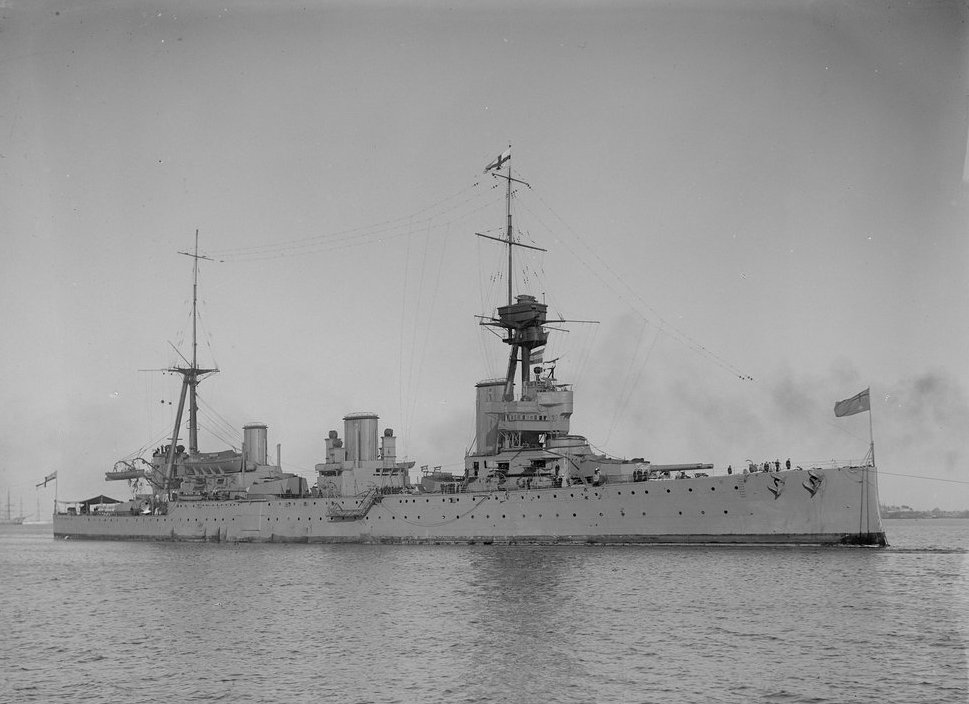
HMAS Australia (1911) was a prominent Indefatigable-class battlecruiser, serving as the flagship of the Royal Australian Navy (RAN) and the only capital ship to serve in the RAN. Constructed by John Brown & Company at Clydebank, her keel was laid in June 1910, and she was launched in October 1911. The ship measured approximately 590 feet (179.8 meters) in length, with a beam of 80 feet (24.4 meters), and a maximum draught of 30 feet 4 inches (9.2 meters). Displacing around 18,500 long tons at load, she was powered by Parsons steam turbines rated at 44,000 shaft horsepower, which during trials produced 55,000 shp, giving her a top speed of nearly 27 knots (about 50 km/h). Her range was approximately 6,690 nautical miles at 10 knots. Armament comprised eight BL 12-inch (305 mm) guns in four twin turrets—two on the centerline fore and aft, and two wing turrets—along with sixteen BL 4-inch (102 mm) guns in casemates, two submerged 18-inch torpedo tubes, and twelve torpedoes. Her armor belt ranged from 4 to 6 inches thick, with main turret faces protected by 7 inches of armor, and an armored deck between 1.5 to 2.5 inches thick. Australia’s fire control was enhanced with a director installed by mid-1915, improving gunnery accuracy. Commissioned in June 1913, HMAS Australia played a vital role in early World War I operations, notably deterring the German East Asia Squadron and supporting the occupation of German colonies in the Pacific. She participated in patrols, cruises, and engagements in the North Sea, including escorting convoys and supporting the Zeebrugge Raid. Notably, she collided with her sister ship HMS New Zealand during a foggy maneuver in April 1916, sustaining damage that required repairs in the UK. Australia was also involved in the pursuit of German naval forces and supported Allied efforts in the Atlantic and Pacific theaters. Post-war, her role was reduced to training and reserve, and she was disarmed in compliance with the Washington Naval Treaty. Decommissioned in 1921, she was scuttled off Sydney Heads in April 1924 under treaty obligations, marking the end of her service. Her wreck is located at a depth of 270 meters and is protected as a historic shipwreck. Her legacy includes artifacts such as her ship’s bell, now displayed at the Australian War Memorial, symbolizing her significance in Australian naval history.
This description has been generated using GPT-4.1-NANO based on the Vessel's wikidata information and then modified by ShipIndex.org staff.