
HMS Electra
1934 E-class destroyer
Vessel Wikidata
* This information from Wikidata is available under the Creative Commons Attribution-ShareAlike License
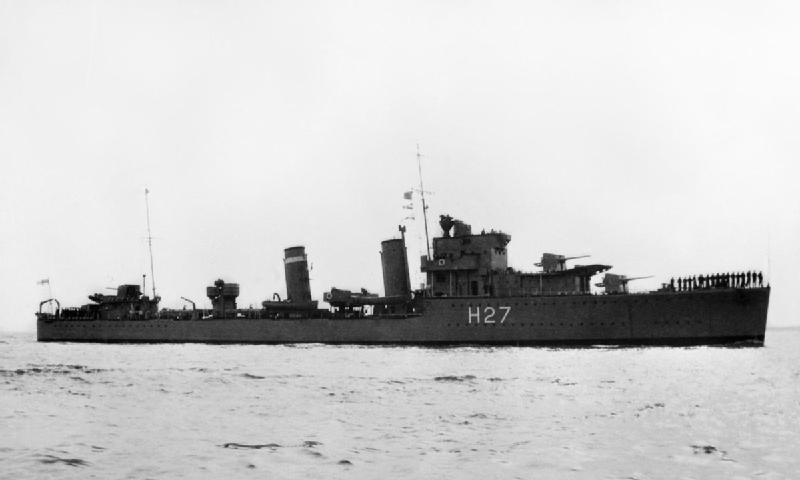
HMS Electra was an E-class destroyer of the Royal Navy, constructed during the 1930s. Displacing approximately 1,405 long tons at standard load and 1,940 long tons at deep load, she measured 329 feet in length with a beam of 33 feet 3 inches and a draught of 12 feet 6 inches. Her propulsion system consisted of two Parsons geared steam turbines powered by three Admiralty three-drum boilers, collectively generating 36,000 shaft horsepower, enabling her to reach a maximum speed of 35.5 knots. Electra carried a fuel oil capacity of 470 long tons, providing a range of 6,350 nautical miles at 15 knots. Her crew complement was 145 officers and ratings. Electra's armament included four 4.7-inch (120 mm) Mark IX guns in single mounts, designed primarily for surface targets. For anti-aircraft defense, she was equipped with two quadruple Mark I mounts for 0.5-inch Vickers machine guns and a 20 mm Oerlikon gun added during refits. Her torpedo armament featured two quadruple 21-inch (533 mm) torpedo tube mounts. Additionally, her anti-submarine weaponry comprised one depth charge rack, two throwers, and initially 20 depth charges, increased to 35 during wartime. Launched on 15 February 1934 at the Hawthorn Leslie Shipyard in Hebburn, Tyneside, Electra was commissioned in 1934 and initially assigned to the 5th Destroyer Flotilla of the Home Fleet. She saw active service during the Spanish Civil War with Non-Intervention Patrols and participated in various fleet movements, including transfers to the Mediterranean. At the outbreak of World War II, Electra was part of the 12th Destroyer Flotilla, engaging in convoy escort, patrols, and anti-submarine operations. Electra was notably involved in the rescue of survivors from the torpedoed liner Athenia in September 1939 and participated in the Battle of the Denmark Strait, where she was among the ships hunting the German battleship Bismarck. She also played a role in the Battle of Narvik, leading to her severe bow damage after colliding with HMS Antelope during an aircraft attack. Throughout her service, Electra took part in numerous significant operations, including Arctic convoy escort missions, the sinking of the Prince of Wales and Repulse, and the Battle of the Java Sea. She was eventually sunk in the Battle of the Java Sea on 27 February 1942 after engaging Japanese forces. Her wreck was discovered in 2003, lying on her port side approximately 160 feet below the water surface, though it was badly damaged by illegal salvagers by 2016. The vessel's history marks her as a witness to many pivotal naval engagements of the Second World War.
This description has been generated using GPT-4.1-NANO based on the Vessel's wikidata information and then modified by ShipIndex.org staff.