
HMS Gloucester
1937 Gloucester-class light cruiser
Vessel Wikidata
* This information from Wikidata is available under the Creative Commons Attribution-ShareAlike License
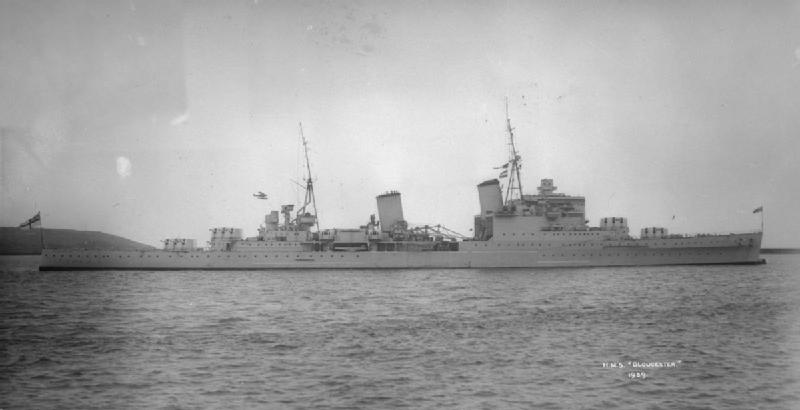
HMS Gloucester was a second-batch Town-class light cruiser of the Royal Navy, commissioned in August 1939 just before the outbreak of World War II. Displacing approximately 9,400 long tons at standard load and up to 11,650 long tons at deep load, she measured about 591 feet 6 inches in length, with a beam of 62 feet 4 inches and a draught of 20 feet 7 inches. Powered by four Parsons geared steam turbines driving four shafts and fueled by four Admiralty 3-drum boilers, Gloucester could reach a maximum speed of 32 knots, with a range of 6,000 nautical miles at 14 knots. Her crew numbered around 800 to 815 officers and ratings. Her armament included twelve 6-inch (152 mm) guns arranged in four triple turrets ('A', 'B', 'X', and 'Y'), eight 4-inch (102 mm) dual-purpose guns in twin mounts, and anti-aircraft weapons comprising quadruple mounts for 2-pounder (40 mm) "pom-poms" and 0.5-inch Vickers machine guns. She was also equipped with two triple 21-inch torpedo mounts for underwater attack. The ship’s armor protection was modest compared to later cruisers, with 4.5 inches of armor on the sides of her boiler, engine rooms, and magazines, and 2 inches on the top of magazines and machinery spaces. The main gun turrets had 1–2 inches of armor. Built at the John Brown shipyard, she was laid down on 22 September 1936 and launched on 19 October 1937 by Princess Alice, Duchess of Gloucester. During her sea trials in November 1938, she recorded an average speed of 31.92 knots. After her commissioning on 31 January 1939, HMS Gloucester served initially on the China Station, later participating in patrols in the Indian Ocean and South Atlantic in search of German commerce raiders. In mid-1940, she was transferred to the Mediterranean Fleet, engaging in convoy escort duties and participating in notable battles such as Calabria and Cape Matapan. Her service was marked by active engagement in bombardments and convoy operations supporting Malta and Greece. Despite her active service, Gloucester sustained damage from Italian bombers in July 1940, including a hit that killed her captain and temporarily impaired her steering. Her distinguished service earned her the nickname "The Fighting G," and she earned five battle honors in less than a year. Tragically, HMS Gloucester was sunk by German dive bombers on 22 May 1941 during the Battle of Crete, with the loss of 722 men out of a crew of 807. Her sinking was a significant event in her maritime history, exemplifying the intense dangers faced by Royal Navy cruisers in WWII. Her wreck remains a controlled site under the Protection of Military Remains Act 1986.
This description has been generated using GPT-4.1-NANO based on the Vessel's wikidata information and then modified by ShipIndex.org staff.