
HMS Hardy
1936 G and H-class destroyer
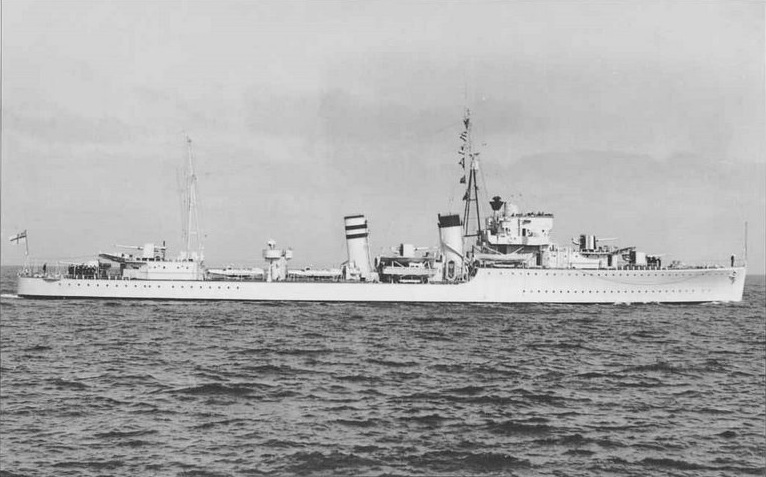
Vessel Wikidata
* This information from Wikidata is available under the Creative Commons Attribution-ShareAlike License
HMS Hardy was a Royal Navy H-class destroyer constructed in the mid-1930s, serving as the flotilla leader for her class. She displaced approximately 1,455 long tons at standard load and around 2,053 long tons at deep load. The vessel measured 337 feet in overall length, with a beam of 34 feet and a draught of 12 feet 9 inches. Hardy was powered by Parsons geared steam turbines, which developed a total of 38,000 shaft horsepower, enabling her to reach speeds up to 36 knots. Her propulsion system was fueled by three Admiralty 3-drum water-tube boilers, and she carried a maximum of 470 long tons of fuel oil, granting her a range of 5,530 nautical miles at 15 knots. The ship's complement consisted of 175 officers and men. Armament on HMS Hardy included five 4.7-inch (120 mm) Mark IX guns in single mounts, providing her with significant firepower for her class. For anti-aircraft defense, she was equipped with two quadruple Mark I mounts for 0.5-inch Vickers machine guns. Her torpedo armament featured two above-water quadruple 21-inch torpedo tube mounts. Additionally, she was fitted with depth charge equipment, initially carrying 20 depth charges, later increased to 35, for anti-submarine warfare. Constructed by Cammell Laird and Company at Birkenhead, Hardy was laid down on 30 May 1935, launched on 7 April 1936, and commissioned on 11 December 1936 at a cost of £278,482. Initially assigned to the Mediterranean Fleet, she patrolled Spanish waters during the Spanish Civil War, enforcing the arms blockade. In 1939, after her refit in Devonport, she was transferred to Freetown, Sierra Leone, to hunt German commerce raiders, and later became flagship of the 2nd Destroyer Flotilla of the Home Fleet. Hardy's most notable engagement occurred during the Norwegian campaign in 1940 at Narvik, where she led a dawn attack on German ships, sinking the Z21 Wilhelm Heidkamp and damaging others. She was critically damaged in this battle, mortally wounded her commanding officer, Captain Warburton-Lee, and was run aground to prevent sinking. The ship was eventually lifted by the tide and capsized in shallow waters, with her wreck visible as late as 1963. Her service highlights her role in early WWII naval operations, including patrols, convoy escort, and combat actions in Norwegian waters.
This description has been generated using GPT-4.1-NANO based on the Vessel's wikidata information and then modified by ShipIndex.org staff.