
HMS Warwick
1917 V and W-class destroyer
Vessel Wikidata
* This information from Wikidata is available under the Creative Commons Attribution-ShareAlike License
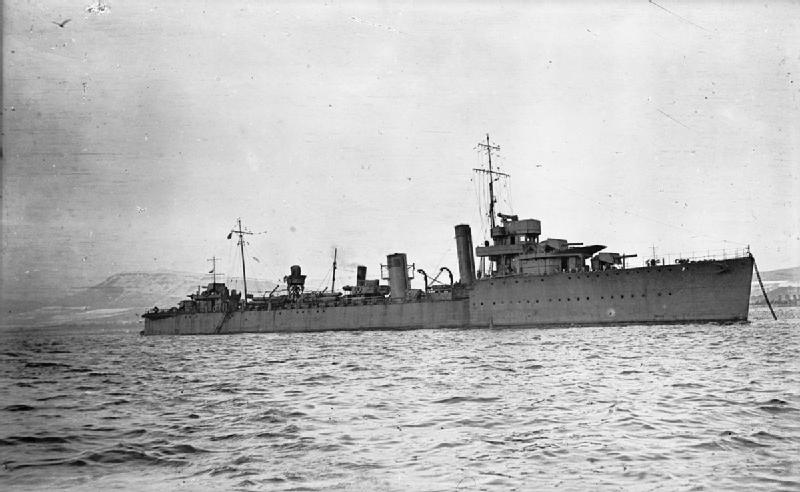
HMS Warwick (D25) was an Admiralty W-class destroyer constructed in 1917, measuring 312 feet (95.1 meters) in overall length with a beam of 26 feet 6 inches (8.08 meters). Her displacement was approximately 1,100 long tons (1,100 tonnes) standard, increasing to 1,490 long tons (1,510 tonnes) at deep load. Powered by three oil-fed Yarrow boilers generating steam at 250 psi, she drove Brown-Curtis geared steam turbines producing 27,000 shaft horsepower, enabling a maximum speed of 34 knots (63 km/h). Her fuel capacity allowed a range of about 3,500 nautical miles at 15 knots. Armament included four 4-inch Mk V QF guns arranged in single mounts along the centerline—two forward and two aft—and a single 3-inch (76 mm) anti-aircraft gun positioned aft of the second funnel. Additionally, she carried six 21-inch torpedo tubes in two triple mounts on the centerline. Notably, Warwick was one of 13 V and W-class destroyers converted for minelaying during WWI, fitted with rails for up to 66 mines. Laid down on 10 March 1917 at Leslie's Hebburn shipyard, she was launched on 28 December 1917 and commissioned on 21 February 1918. She saw active service in the final months of WWI, notably participating in the raid on Zeebrugge as Vice-Admiral Roger Keyes' flagship, and in the second raid on Ostend. During these operations, she provided cover and support, including laying smoke screens and rescuing survivors from damaged ships. Warwick was heavily damaged after striking a German mine in May 1918 but was repaired and continued her service, including deployments in the Baltic Sea during the Russian Civil War, and various patrols and fleet reviews. She remained active through the interwar period, undertaking convoy escort, patrols, and diplomatic duties. In WWII, Warwick transitioned to anti-submarine and convoy escort roles, operating primarily from Devonport. She was modified in 1943 for extended range and increased anti-submarine capabilities, including the fitting of Hedgehog mortars and additional depth charges. Her service included operations off Norway, the Atlantic, and the Caribbean. On 20 February 1944, while hunting a German U-boat, she was torpedoed and sunk by U-413 near Trevose Head, with the loss of 67 crew members. Her sinking marked the end of her distinguished service, illustrating her vital role in both world wars and her maritime significance as a versatile and resilient Royal Navy destroyer.
This description has been generated using GPT-4.1-NANO based on the Vessel's wikidata information and then modified by ShipIndex.org staff.