
HMCS Dundas
1941 Flower-class corvette
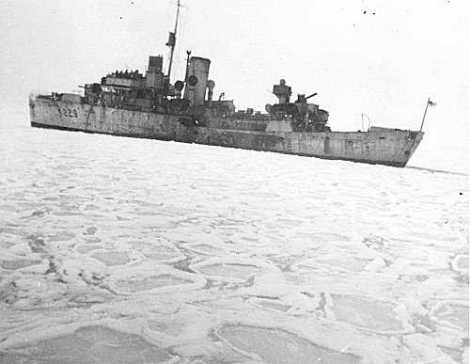
Vessel Wikidata
* This information from Wikidata is available under the Creative Commons Attribution-ShareAlike License
HMCS Dundas was a Flower-class corvette that served with the Royal Canadian Navy during the Second World War. Laid down on 19 March 1941 by Victoria Machinery Depot Co. Ltd. in Victoria, British Columbia, she was launched on 25 July 1941 and commissioned on 1 April 1942. Built as part of the 1940–1941 Flower-class program, Dundas featured water-tube boilers, which provided reliable steam supply despite being less responsive. Unlike earlier ships in her class, she was not equipped with minesweeping gear, reflecting her role shift from coastal auxiliary duties to convoy escort. Dundas’s service included notable deployments in both the Atlantic and Pacific theaters. She initially joined the Esquimalt Force at Esquimalt, British Columbia, and in August 1942, participated in escorting convoys to Alaska as part of the Aleutian Islands Campaign. Afterward, she was reassigned to the east coast of Canada in September 1942, replacing corvettes heading to Operation Torch. Upon arriving in Halifax on 13 October 1942, she joined the Western Local Escort Force (WLEF). Throughout her service, Dundas was assigned to various convoy escort groups, including W-7, W-5, and W-4, providing critical protection to Allied shipping until the end of the war. The vessel underwent two major refits: the first at Montreal from June to November 1943, during which her forecastle was extended; the second at Liverpool, Nova Scotia, in early 1945. These refits improved her seaworthiness and operational capabilities. HMCS Dundas was paid off on 17 July 1945 at Sorel, Quebec, transferred to the War Assets Corporation, and subsequently sold for scrapping on 23 October 1945. She was broken up in 1946 at Hamilton, Ontario. Her service exemplifies the vital role played by Canadian Flower-class corvettes in safeguarding Atlantic convoys and supporting Allied maritime efforts during the war.
This description has been generated using GPT-4.1-NANO based on the Vessel's wikidata information and then modified by ShipIndex.org staff.