
HMCS Frontenac
1943 modified Flower-class corvette
Vessel Wikidata
* This information from Wikidata is available under the Creative Commons Attribution-ShareAlike License
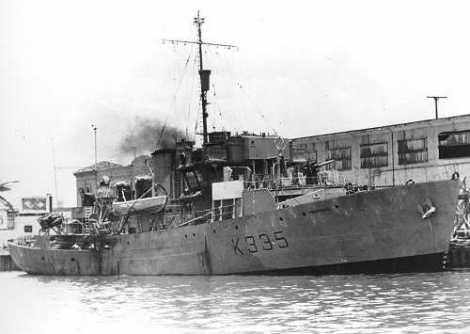
HMCS Frontenac was a modified Flower-class corvette serving with the Royal Canadian Navy during the Second World War, primarily engaged in the Battle of the Atlantic as a convoy escort. Built by Kingston Shipbuilding Co. in Kingston, Ontario, she was laid down on 19 February 1943, launched on 2 June 1943, and commissioned on 26 October 1943. The vessel was part of the 1942-43 modified Flower-class program, known as the Increased Endurance (IE), which incorporated several improvements based on wartime lessons. Physically, HMCS Frontenac featured significant modifications from earlier Flower-class corvettes. Her bridge was raised to a full deck height and built to naval standards, providing better visibility and durability. The platform for her 4-inch main gun was elevated to reduce spray and improve firing capabilities, and she was equipped with a Hedgehog anti-submarine mortar, marking a notable upgrade in her armament. The vessel’s silhouette was also altered by an upright funnel and pressurized boiler rooms, making her less identifiable to submariners. Throughout her service, Frontenac underwent a major refit starting in January 1945 at Liverpool, Nova Scotia, which lasted three months. After her initial workups, she joined the Royal Navy-controlled convoy escort group EG 9 out of Derry but returned to Canada shortly thereafter. In May 1944, she became part of the Mid-Ocean Escort Force’s C-1 group operating from St. John’s, escorting trans-Atlantic convoys until December 1944. Following her refit, she was assigned to Halifax Force, where she remained until the end of the war. HMCS Frontenac was paid off on 22 July 1945 at Halifax, transferred to the War Assets Corporation, and subsequently laid up at Sorel, Quebec. In October 1945, she was sold to the United Ship Corporation. Her service exemplifies the Canadian adaptation of Flower-class corvettes for Atlantic convoy duty, highlighting improvements in design and operational roles that contributed significantly to Allied maritime efforts during WWII.
This description has been generated using GPT-4.1-NANO based on the Vessel's wikidata information and then modified by ShipIndex.org staff.