
SMS Prinz Adalbert
Prussian ironclad
Vessel Wikidata
* This information from Wikidata is available under the Creative Commons Attribution-ShareAlike License
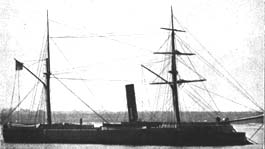
SMS Prinz Adalbert was an ironclad warship constructed in Bordeaux, France, in 1864, originally intended for the Confederate States Navy and secretly built under the cover name Cheops. She measured approximately 50.48 meters (165 feet 7 inches) at the waterline and 56.96 meters (186 feet 11 inches) overall, with a beam of 9.92 meters (32 feet 7 inches) and a draft of around 5 meters (16 feet 6 inches). The vessel displaced roughly 1,440 metric tons at normal load, increasing to about 1,560 tons at full load. Her hull combined iron and timber, with transverse frames and copper sheathing to prevent fouling. She featured a pronounced tumblehome design and was considered a poor seaboat, particularly due to her ram bow, which caused excessive water intake and instability, though she was responsive to helm commands and had a tight turning radius. Powered by twin 2-cylinder single-expansion steam engines supplied by Mazeline of Le Havre, she achieved a top speed of approximately 9.5 knots, propelled by two screw propellers and two trunk boilers. Her propulsion system generated around 1,200 PS (1,184 ihp). Initially rigged with a brig sailing rig, her sails were later replaced with a topsail schooner rig for supplementary propulsion. Her armament consisted of three rifled muzzle-loading guns: a 21 cm (8.3 inches) gun in a bow casemate and two 17 cm (6.7 inches) guns in fixed turrets amidships, later replaced by Krupp guns after her arrival in Prussia. Constructed secretly in France, she was bought by Prussia during the Second Schleswig War, but delivery was delayed until after the conflict. She was renamed Prinz Adalbert in October 1866, in honor of Prince Adalbert of Prussia, and commissioned shortly thereafter. Her early service revealed numerous construction flaws; she leaked badly, had poor hull integrity due to low-quality wood, and suffered from rust and corrosion issues, especially between her iron armor and copper sheathing. Her limited operational life was marked by frequent repairs, including hull rework and rig reconfiguration. She served briefly as a guard ship during the Franco-Prussian War, primarily in Hamburg, but her poor condition and structural deficiencies curtailed her effectiveness. Decommissioned in 1871, she was eventually stricken in 1878 and broken up for scrap, with her engines and armor repurposed. Her short, troubled career exemplifies the challenges of early ironclad construction and the transitional period of naval technology during the 1860s.
This description has been generated using GPT-4.1-NANO based on the Vessel's wikidata information and then modified by ShipIndex.org staff.