
SMS Magdeburg
1911 Magdeburg-class cruiser
Vessel Wikidata
* This information from Wikidata is available under the Creative Commons Attribution-ShareAlike License
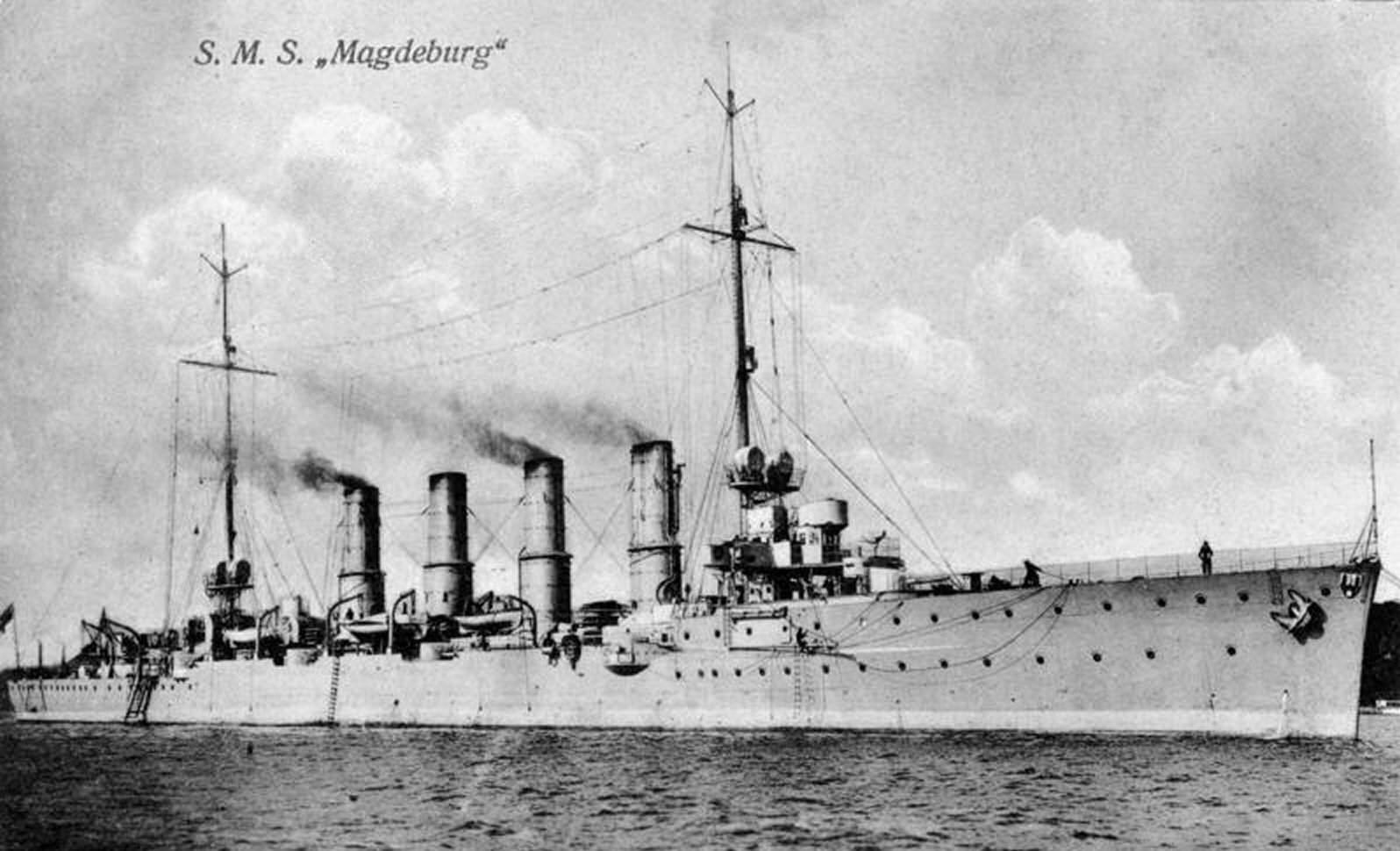
SMS Magdeburg was the lead ship of the Magdeburg class of light cruisers built for the German Kaiserliche Marine. Constructed at the AG Weser shipyard in Bremen between 1910 and August 1912, she measured approximately 138.7 meters (455 feet 1 inch) in overall length with a beam of 13.5 meters (44 feet 3 inches) and a draft of 4.4 meters (14 feet 5 inches). Displacing around 4,535 tons normally and up to 4,570 tons at full load, Magdeburg featured a streamlined hull with a short forecastle deck and minimal superstructure, primarily consisting of a conning tower located forward. Her propulsion system comprised three sets of Bergmann steam turbines driving three screw propellers, designed to produce 25,000 shaft horsepower but reaching nearly 29,904 shp in service, powered by sixteen coal-fired marine-type water-tube boilers later converted to use oil and coal sprayed with oil. This machinery enabled a top speed of approximately 27.6 knots (51.1 km/h). Armament included twelve 10.5 cm SK L/45 guns arranged with two forward, eight amidships, and two aft, providing a maximum engagement range of about 12,700 meters. She was also equipped with two submerged 50 cm torpedo tubes with five torpedoes and could carry up to 120 mines. The armor protection consisted of a 60 mm waterline belt, an angled 60 mm deck, and a 100 mm thick conning tower. Commissioned in August 1912 under FK Heinrich Rohardt, Magdeburg initially served as a torpedo test ship before being deployed to active duty in the Baltic at the outbreak of World War I. Her service was marked by early engagements, including shelling the Russian port of Libau on August 2, 1914, and participating in operations against Russian forces in the Baltic. A notable event occurred on August 26, 1914, when she ran aground off Odensholm during a Baltic sortie, was engaged by Russian cruisers, and was ultimately captured after German efforts to destroy her failed. The Russians recovered her intact, including three German code books, which significantly aided British naval intelligence by providing crucial cipher information. Her wreck was later partially scrapped by the Russians. The capture of her code books proved historically significant, as it allowed the British Royal Navy to decipher German wireless signals, leading to successful ambushes at the Battles of Dogger Bank and Jutland. Thus, SMS Magdeburg played a pivotal role in early WWI naval history, both in combat and in the intelligence domain.
This description has been generated using GPT-4.1-NANO based on the Vessel's wikidata information and then modified by ShipIndex.org staff.