
Thomas W. Lawson
seven-masted, steel-hulled schooner
Vessel Wikidata
* This information from Wikidata is available under the Creative Commons Attribution-ShareAlike License
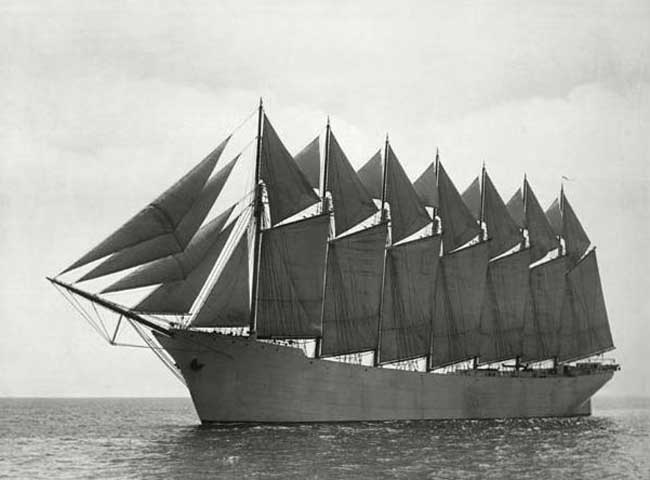
The Thomas W. Lawson was an extraordinary seven-masted schooner constructed primarily of steel, launched in 1902. Designed by renowned naval architect Bowdoin B. Crowninshield for Captain John G. Crowley of the Coastwise Transportation Company, she was built by the Fore River Ship and Engine Company at a cost of approximately $250,000. At 475 feet overall length and 395 feet on deck, she was the largest schooner and the largest pure sailing vessel ever constructed without auxiliary power. Her seven masts, each reaching 193 feet, carried 25 sails covering roughly 43,000 square feet of canvas, and her hull was painted white initially, later black. The vessel featured a steel hull with high bulwarks and a double cellular bottom four feet deep, incorporating 1,000 tons of water ballast. She measured 5,218 gross register tons and could carry nearly 11,000 tons of coal, although her capacity was often reduced to 7,400 tons to navigate shallower ports. Her design included two continuous decks, a poop deck, forecastle, and a sizable superstructure with captain’s quarters, officers' rooms, and recreational spaces. Power was supplemented by two steam winches, and she was equipped with massive anchors weighing five tons each. Initially built for the Pacific trade, her service was quickly diverted to hauling coal and later oil along the U.S. East Coast. In 1906, she was retrofitted as a bulk oil carrier, becoming the world's first pure sailing tanker under charter to Sun Oil Company, capable of transporting 60,000 barrels of oil. Despite her impressive size and design, she was often criticized for poor maneuverability and sluggish sailing qualities, due to her hull and sail area proportions. Her tragic end occurred in December 1907 during a storm off the Isles of Scilly. While sailing from Marcus Hook Refinery to London with 58,000 barrels of light paraffin oil, she grounded near Annet Island after passing inside Bishop Rock lighthouse in stormy conditions. The ship was battered by heavy seas, lost all masts, and eventually broke apart against Shag Rock, resulting in the loss of 16 of her 18 crew members and the pilot. The wreckage remains scattered near the Isles of Scilly, and her anchors and a memorial exist as reminders of her maritime significance.
This description has been generated using GPT-4.1-NANO based on the Vessel's wikidata information and then modified by ShipIndex.org staff.