
SMS Friedrich der Grosse
1911 Kaiser-class battleship
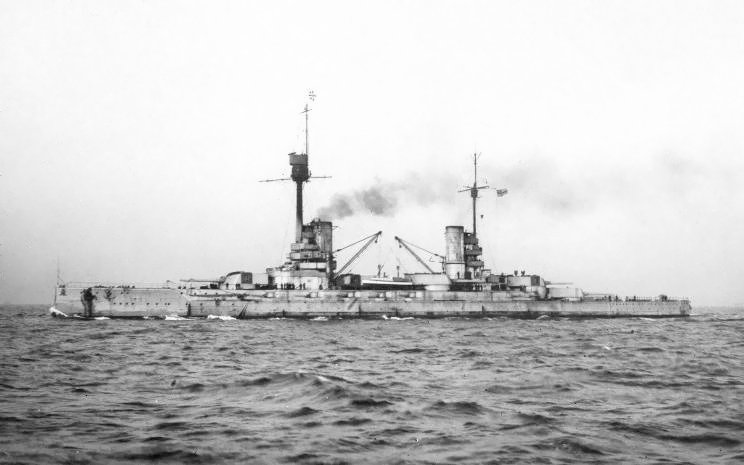
Vessel Wikidata
* This information from Wikidata is available under the Creative Commons Attribution-ShareAlike License
SMS Friedrich der Grosse was a Kaiser-class dreadnought battleship built for the German Imperial Navy, representing a significant advancement in German battleship design during the early 20th century. Laid down on 26 January 1910 at the AG Vulcan dockyard in Hamburg and launched on 10 June 1911, she was commissioned into the fleet on 15 October 1912. The ship measured approximately 172.4 meters (565 ft 7 in) in length overall and displaced up to 27,000 metric tons at full load. Her beam was about 29 meters (95 ft 2 in), with a draft of roughly 9.1 meters (29 ft 10 in) forward. She featured a relatively minimal superstructure, with a short armored conning tower forward and a secondary one aft, supported by pole masts for observation and signaling. Friedrich der Grosse’s propulsion system comprised three sets of AEG Curtis turbines powered by sixteen coal-fired water-tube boilers, enabling her to reach a top speed of approximately 22.4 knots (41.5 km/h). Her range was about 7,900 nautical miles at a cruising speed of 12 knots, thanks to her coal capacity of 3,600 tons. Her armament included ten 30.5 cm (12 in) SK L/50 guns arranged in five twin turrets—three on the centerline and two superfiring aft—along with fourteen 15 cm (5.9 in) guns, eight 8.8 cm (3.5 in) guns for close defense, four 8.8 cm anti-aircraft guns, and five torpedo tubes. Her armor consisted of a main belt up to 350 mm (13.8 in) thick, with turret armor of 300 mm (11.8 in) and a heavily armored conning tower with 400 mm (15.7 in) sides. Service-wise, Friedrich der Grosse served as the fleet flagship until 1917 and participated in all major German fleet operations during World War I, including the Battle of Jutland. During the battle, she was positioned towards the center of the German line, emerging undamaged from the engagement. Throughout the war, she took part in various sorties, bombardments, and Baltic operations, notably supporting the seizure of the Russian port of Riga. After Germany’s defeat, she was interned at Scapa Flow with the High Seas Fleet. On 21 June 1919, she was scuttled by her crew to prevent seizure by the British. Raised in 1936, she was dismantled for scrap in 1938. Her bell was returned to Germany in 1965 and is now housed at the Fleet Headquarters in Glücksburg. Friedrich der Grosse remains a notable example of early 20th-century German dreadnought design and naval strategy.
This description has been generated using GPT-4.1-NANO based on the Vessel's wikidata information and then modified by ShipIndex.org staff.