
SS La Bretagne
ocean liner (1886–1923)

Vessel Wikidata
* This information from Wikidata is available under the Creative Commons Attribution-ShareAlike License
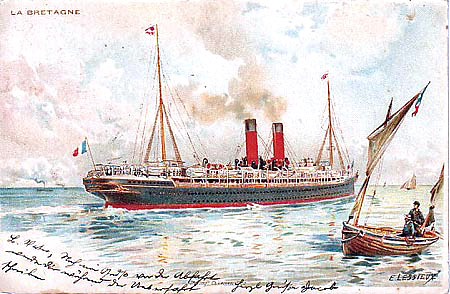
The SS La Bretagne was an ocean liner built for the French shipping company Compagnie Générale Transatlantique (CGT), launched on September 9, 1885, in Saint-Nazaire. She measured approximately 150.99 meters (495 feet 4 inches) in length between perpendiculars and 15.78 meters (51 feet 9 inches) in beam, with a gross register tonnage of 7,112 GRT. Constructed of steel with eleven bulkheads creating twelve watertight compartments, her hull featured Canadian elm and teak decking. The vessel was equipped with twin triple-expansion steam engines, capable of propelling her at 17 knots, and was fitted with two funnels and four masts carrying a barquentine rig. Her initial passenger accommodations included space for 390 first-class, 65 second-class, and 600 third-class passengers, reflecting her role as a transatlantic passenger liner operating between Le Havre and New York. Her design was notable for its elegance, featuring decorations by renowned French designer Jules Allard, and her cost was approximately $1.7 million at the time. La Bretagne's service began with her maiden voyage from Le Havre to New York on August 14, 1886, arriving after a stormy crossing. Throughout her career, she was involved in notable events, including the voyage of composer Pyotr Ilyich Tchaikovsky in 1891 and a tragic incident where a man threw his child overboard during a passage. She experienced several operational challenges, including quarantine during a cholera outbreak in 1892, a collision with a pier in December of the same year, and a fire aboard the German liner Barbarossa in 1899, which resulted in significant hull damage to La Bretagne. Her engines were upgraded from triple-expansion to quadruple-expansion in 1895, and her third-class capacity was nearly tripled. She was also involved in rescue operations, notably saving the crew of the dismasted British bark Bothnia in 1898. Later, she served on South American routes after being sold to the Compagnie de Navigation Sud-Atlantique in 1912, and her name was changed to SS Alesia in her final years. She was sold for scrap in December 1923 but was lost en route to the breakers when she ran aground on Texel during her tow to the Netherlands. Her career exemplifies the evolution and challenges of late 19th and early 20th-century ocean liners.
This description has been generated using GPT-4.1-NANO based on the Vessel's wikidata information and then modified by ShipIndex.org staff.