
RMS Lusitania
British ocean liner sunk by a German submarine in World War I
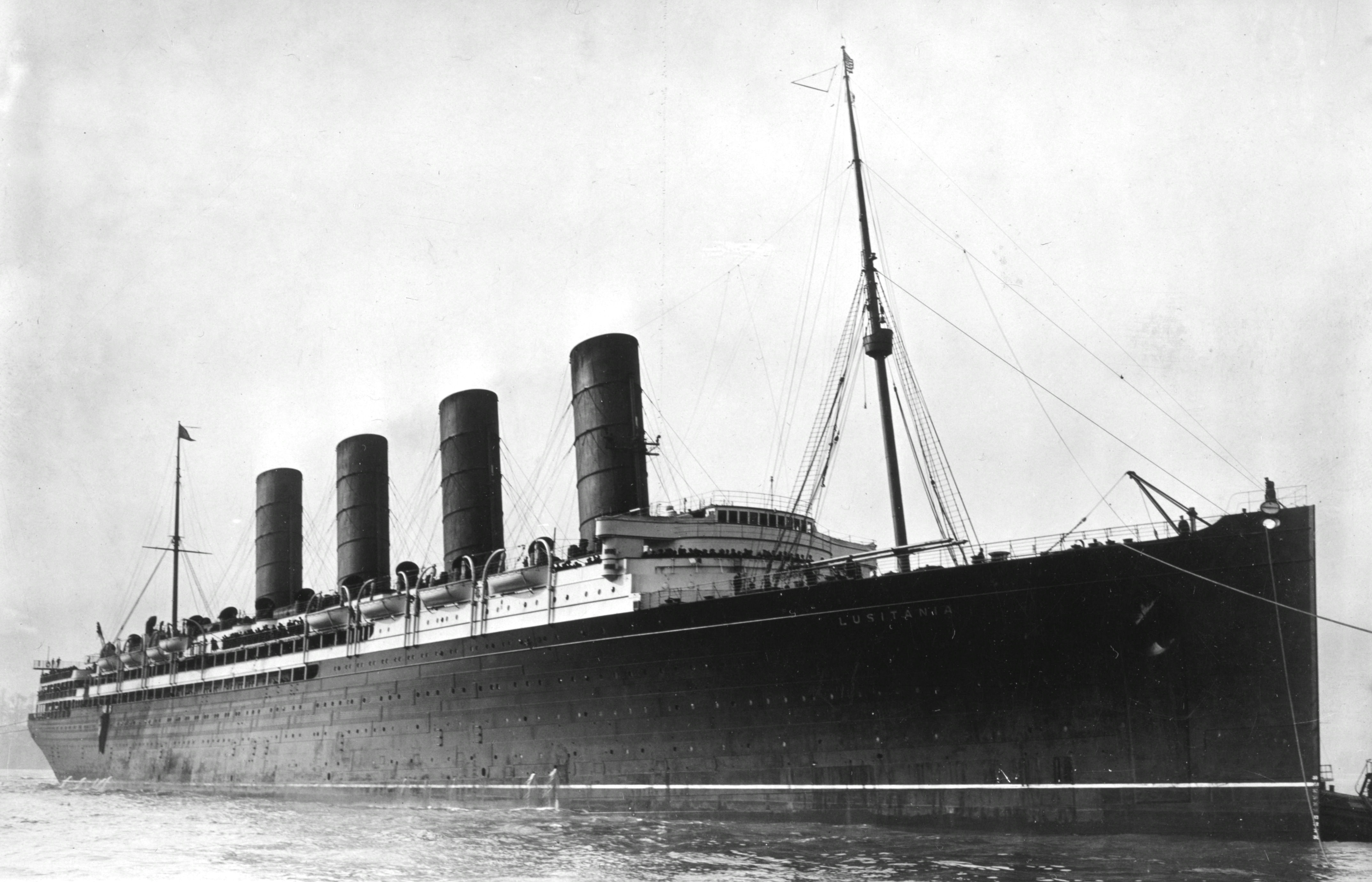
Vessel Wikidata
* This information from Wikidata is available under the Creative Commons Attribution-ShareAlike License
The RMS Lusitania was a British ocean liner launched in 1906 by the Cunard Line, designed as a luxurious and technologically advanced passenger vessel. She was constructed by John Brown and Company of Clydebank, Scotland, and quickly established herself as a symbol of maritime excellence. At her completion, Lusitania was briefly the largest passenger ship in the world, measuring approximately 787 feet in length with a beam of about 87 feet, and a gross tonnage of 44,000 tons. Her design featured a distinctive four-funnel configuration and was powered by steam turbine engines capable of maintaining a service speed of 24 knots, making her the fastest Atlantic crossing at the time, a record she held briefly in 1907. Constructed with high-tensile steel, Lusitania's hull boasted 13 watertight compartments, providing enhanced safety, though her design included longitudinal bulkheads outside the transverse bulkheads, which contributed to some structural vulnerabilities. She was equipped with modern amenities for her era, including wireless telegraph, electric lighting, lifts, and air conditioning, with luxurious interiors designed by James Miller, featuring ornate plasterwork, fine wood paneling, and spacious public rooms. Her passenger accommodations were divided into first, second, and third classes, with first-class amenities being particularly sumptuous, including a grand dining saloon, lounge, library, and various private suites. Lusitania's service history included numerous Atlantic crossings, famously setting and breaking the Blue Riband record for the fastest crossing in 1907 and 1909. She was a response to fierce competition from German liners like the Kaiser Wilhelm der Grosse and later the Olympic-class ships. During her operational years, she carried thousands of passengers, including emigrants and luxury travelers, and was known for her elegance and speed. Her maritime significance was marred by her sinking on 7 May 1915 by a German U-boat off the coast of Ireland, an event that resulted in the loss of 1,197 lives, including over a hundred Americans. The sinking, which involved a torpedo hitting her starboard side and subsequent rapid sinking, played a pivotal role in shifting public opinion in the United States against Germany and contributed to the eventual American entry into World War I. The wreck lies on her starboard side at about 305 feet in depth, in a deteriorated state, with ongoing archaeological and salvage efforts. Lusitania remains a symbol of early 20th-century maritime achievement and wartime tragedy.
This description has been generated using GPT-4.1-NANO based on the Vessel's wikidata information and then modified by ShipIndex.org staff.