
CS Mackay-Bennett
Halifax Cable Ship famous for its retrieval of Titanic victim's bodies following disaster.
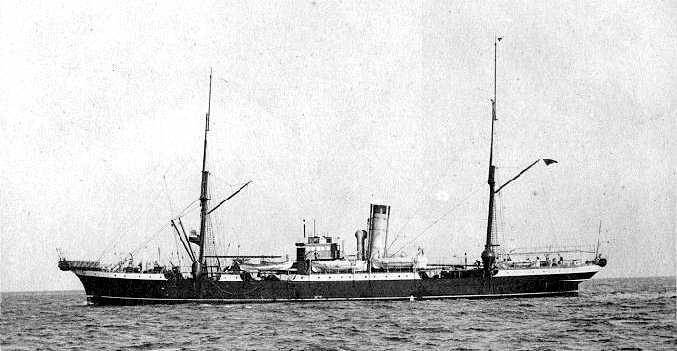
Vessel Wikidata
* This information from Wikidata is available under the Creative Commons Attribution-ShareAlike License
The CS Mackay-Bennett was a steel-hulled transatlantic cable-laying and repair ship built by John Elder & Co. at their Fairfield Yards on the River Clyde. Launched in late 1884, she was notable for incorporating innovative features for her time, including a deep keel designed to maximize cable capacity and stability in the Atlantic, as well as a hydrodynamic hull shape for fuel efficiency and speed. The vessel was equipped with bilge keels for stability and two rudders—one fore and one aft—to enhance maneuverability. Registered as a Glasgow vessel but owned by the American Commercial Cable Company, the Mackay-Bennett primarily operated out of Halifax, Nova Scotia, and also frequently serviced the European Atlantic from Plymouth, England. Her design allowed her to perform complex cable repairs and maintenance, often in wartime conditions, and she was involved in rescue operations, including the rescue of the crew of the schooner Caledonia in 1912. The ship's most historically significant role occurred in April 1912, after the sinking of the RMS Titanic. She was berthed at Halifax during a period of cable maintenance when she was contracted by the White Star Line to recover bodies from the disaster. Equipped with a large hold capable of storing 125 coffins and ice, and supplied with embalming resources, Mackay-Bennett undertook a meticulous and somber recovery mission. She departed Halifax on 17 April 1912, navigating through fog and rough seas over nearly four days to reach the disaster site. During her seven-day recovery effort, she retrieved 116 bodies, embalmed and placed in coffins, with some bodies, including those of third-class passengers and crew, being buried at sea. The vessel's notable involvement in Titanic recovery efforts, along with her engineering innovations and service record, cement her significance in maritime history. She was retired in 1922, later used as a storage hulk, and was sunk during a German air attack in World War II before being refloated. Her hull was ultimately scrapped in 1965, but her legacy endures, including a seamount named in her honor—Mackay-Bennett Seamount.
This description has been generated using GPT-4.1-NANO based on the Vessel's wikidata information and then modified by ShipIndex.org staff.