
HMS Bayano
1913 banana boat converted to armed merchant cruiser
Vessel Wikidata
* This information from Wikidata is available under the Creative Commons Attribution-ShareAlike License
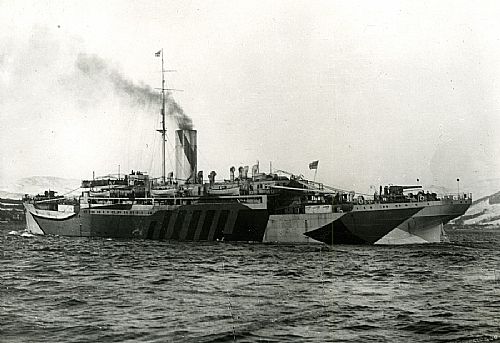
HMS Bayano was originally constructed in 1913 as a banana boat for the Elders & Fyffes line, designed primarily for commercial cargo transport. With a history rooted in civilian service, the vessel was requisitioned by the Royal Navy at the onset of the First World War on 21 November 1914, and converted into an armed merchant cruiser. Although specific dimensions are not provided on the Wikipedia page, her role as an armed merchant cruiser indicates she was equipped with some armament suitable for patrol and escort duties. During her service with the Royal Navy, HMS Bayano was assigned to the Northern Patrol, specifically within the 10th Cruiser Squadron, tasked with blockading and patrolling the North Atlantic and nearby waters. The Admiralty employed experimental indicator nets during this period as a countermeasure against German submarines, including one in the North Channel where HMS Bayano was operating. These indicator nets were constructed from strong, thin wires draped across the sea surface, buoyed by kapok, small buoys, or glass globes, and designed to entangle or signal submarine passages. On 11 March 1915, HMS Bayano was tragically sunk by the German submarine SM U-27 approximately 10 nautical miles west of Corsewall Lighthouse in Galloway. The attack occurred early morning at 05:15, during a period of reduced visibility and darkness. The sinking was rapid, taking only five minutes, and resulted in the loss of the captain, Lieutenant Commander Henry Carr, and 194 crew members. Only 26 survivors were rescued, most of whom were asleep at the time of the attack. The event was notably poignant, with Commander Carr reportedly waving goodbye from the bridge and shouting "Good luck to you boys" as the ship went down. The sinking of HMS Bayano had significant maritime and community repercussions, particularly on the Isle of Man and Newfoundland, where many bodies washed ashore and funeral processions drew thousands, despite the victims not being residents of those areas. The wreck of HMS Bayano was located and identified in 2025. Her loss exemplifies the peril faced by auxiliary cruisers and merchant vessels during WWI, as well as the broader strategic importance of maritime patrols and anti-submarine measures employed during the conflict.
This description has been generated using GPT-4.1-NANO based on the Vessel's wikidata information and then modified by ShipIndex.org staff.