
SMS Pfeil
1882 Blitz-class aviso
Vessel Wikidata
* This information from Wikidata is available under the Creative Commons Attribution-ShareAlike License
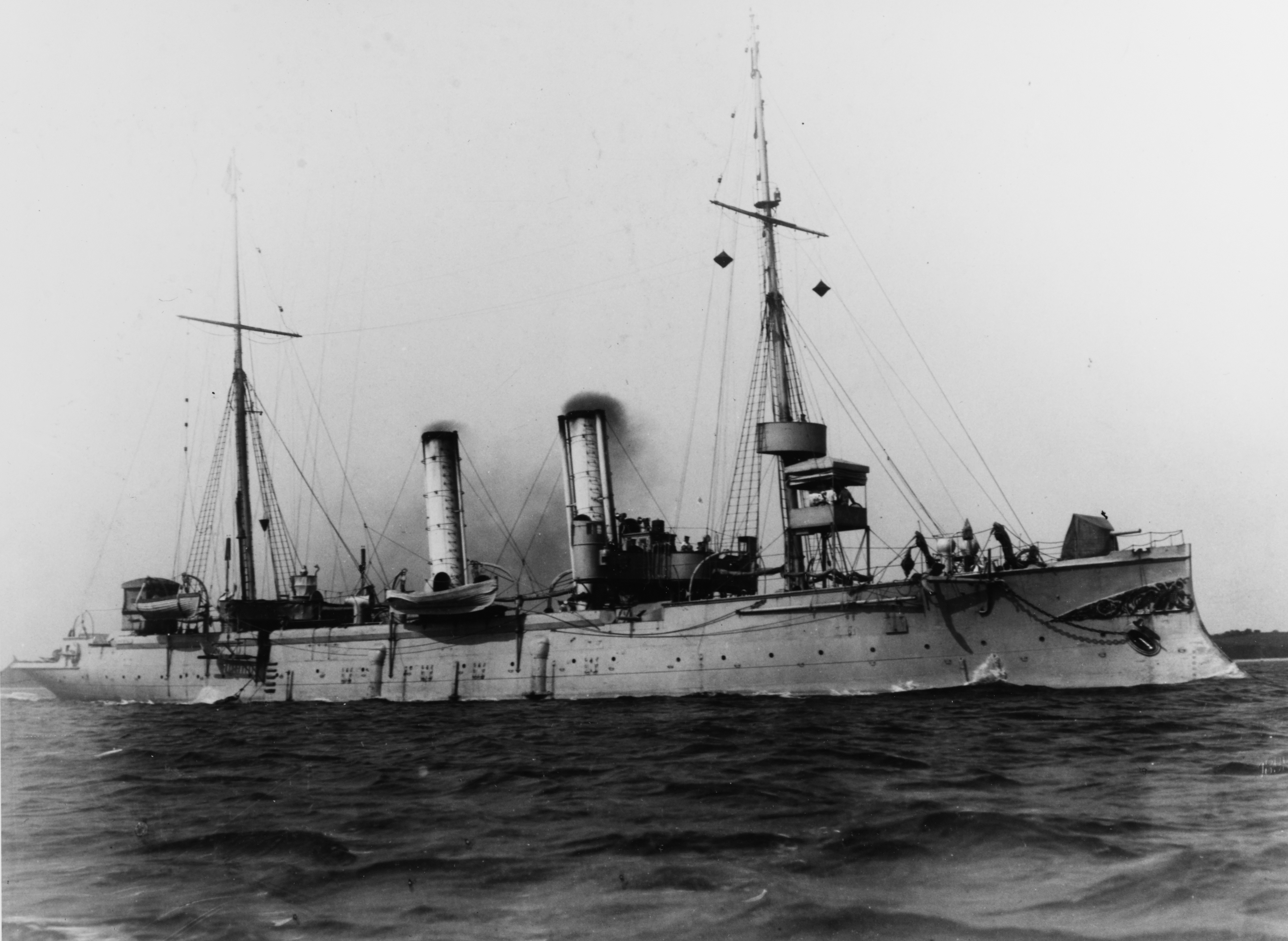
SMS Pfeil was an aviso of the Imperial German Navy and the second and final vessel of the Blitz class, notable for being among the first steel-hulled warships in the German fleet. She measured 78.43 meters (257.3 feet) in length overall, with a beam of 9.9 meters (32 feet) and a maximum draft of 4.07 meters (13.4 feet). Her displacement was 1,381 metric tons (1,359 long tons) at design load, increasing to approximately 1,486 metric tons (1,463 long tons) at full combat load. The ship's crew comprised 7 officers and 127 enlisted men. Propulsion was provided by two horizontal 2-cylinder double expansion engines powered by eight coal-fired cylindrical boilers, rated at 2,700 indicated horsepower, enabling a top speed of 15.6 knots (28.9 km/h; 18.0 mph). Her range was approximately 2,440 nautical miles (4,520 km; 2,810 miles) at a cruising speed of 9 knots (17 km/h). As built, Pfeil was armed with a single 12.5 cm (4.9 inch) K L/23 gun on a pivot mount with 100 rounds, four 8.7 cm (3.4 inch) guns in single mounts, and one 35 cm (13.8 inch) torpedo tube mounted in the bow. Between 1891 and 1892, her armament was upgraded to six 8.8 cm guns in single mounts and three submerged 35 cm torpedo tubes—one in the bow and two on the broadside. Notably, she had no armor protection. Constructed at the Kaiserliche Werft in Wilhelmshaven, Pfeil was launched on September 16, 1882, with Prince Heinrich christening her, and commissioned for sea trials in November 1884. Her early service involved training cruises, fleet exercises, and colonial duties, notably during the suppression of the Abushiri revolt in German East Africa in 1888–1889. She participated in blockade and bombardment operations, and was the first German steel-hulled warship deployed to German colonies. Throughout her career, Pfeil was involved in several accidents, including collisions with a lightship, a torpedo boat, and a schooner, the latter sinking the vessel. She served in various roles, including fishery protection, training ship for engine room crews, and fleet scout. During World War I, she supported torpedo boat flotillas, served as a tender for the High Seas Fleet, and supported harbor defense at the mouth of the Elbe. Decommissioned in December 1918, she was struck from the naval register in 1922 and scrapped at Wilhelmshaven, marking the end of a long and versatile service history.
This description has been generated using GPT-4.1-NANO based on the Vessel's wikidata information and then modified by ShipIndex.org staff.