
Empire Windrush
ship
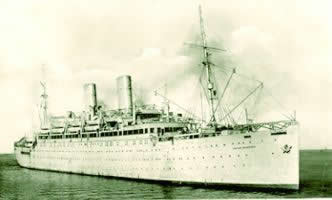
Vessel Wikidata
* This information from Wikidata is available under the Creative Commons Attribution-ShareAlike License
HMT Empire Windrush was a passenger motor ship originally launched in Hamburg, Germany, in 1930 as the MV Monte Rosa. She belonged to the Monte-class of almost identical ships built by Blohm & Voss for Hamburg Süd, with a registered length of approximately 500.3 feet (152.5 meters), a beam of 65.7 feet (20 meters), and a depth of 37.8 feet (11.5 meters). Her tonnage was 13,882 gross register tons (GRT) and 7,788 net register tons (NRT). The vessel was powered by four four-stroke, six-cylinder MAN Diesel engines, delivering a combined 6,880 brake horsepower, which allowed her to reach a speed of about 14 knots. She featured two screw propellers driven via single-reduction gearing, and her electrical power was supplied by three DC generators, with a fourth added later in her service. Initially, Monte Rosa served as an ocean liner carrying German emigrants to South America and as a cruise ship in Northern European waters, Mediterranean, and South America. She was involved in Nazi propaganda activities during the 1930s, hosting rallies and Nazi officials in ports like Argentina and London. During WWII, she was requisitioned by the German navy, serving as a barracks ship, troopship, and partook in deportations of Norwegian and Danish Jews. She also played a role in repairing the German battleship Tirpitz and was targeted by Allied attacks, sustaining damage from air raids and sabotage. After being damaged in 1944 and 1945, Monte Rosa was captured by British forces in May 1945, and her war damage was repaired in Denmark. In 1946, she was transferred to the UK as a prize of war and refitted as a troopship. Renamed HMT Empire Windrush in 1947, she became a symbol of post-war migration, notably making her famous 1948 voyage carrying over 800 Caribbean migrants to the UK, marking the beginning of the Windrush generation. Her subsequent service included many routes between Britain, the Far East, and the Mediterranean until her final voyage in 1954. On 28 March 1954, while in the western Mediterranean, an explosion and fire in her engine room caused her to be abandoned; despite rescue efforts, she sank off the coast of Algeria, with four crew members killed. Her sinking led to an inquiry that concluded she was seaworthy at the time, though her condition had been poor. The ship remains a maritime and cultural icon, symbolizing post-war migration and the history of Caribbean communities in the UK.
This description has been generated using GPT-4.1-NANO based on the Vessel's wikidata information and then modified by ShipIndex.org staff.