
HMS Jervis
1938 K and N-class destroyer
Vessel Wikidata
* This information from Wikidata is available under the Creative Commons Attribution-ShareAlike License
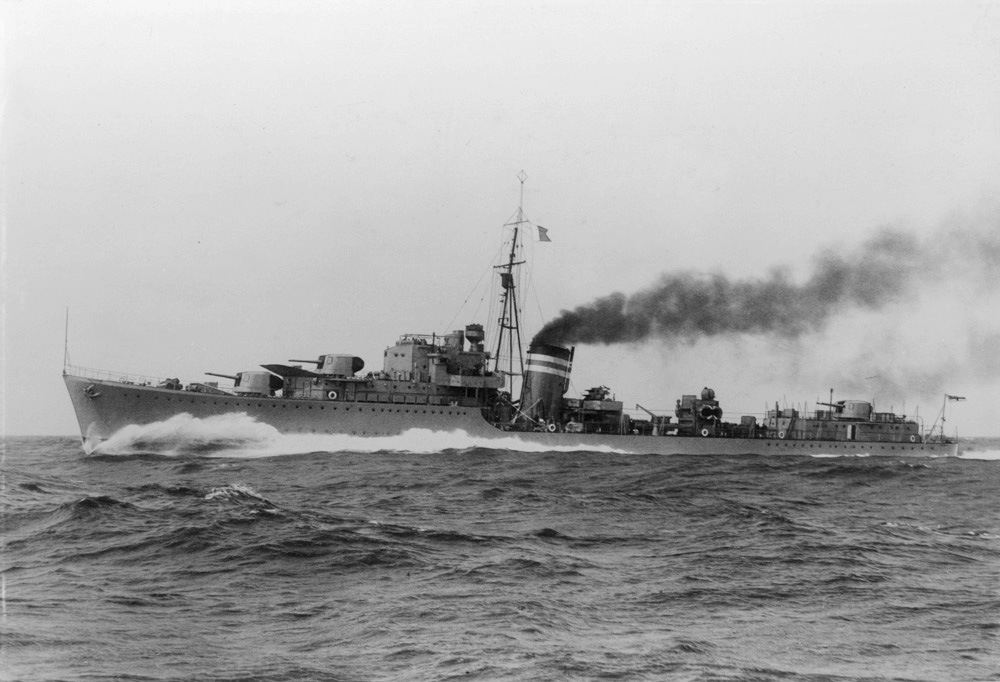
HMS Jervis was a J-class destroyer constructed for the Royal Navy in the late 1930s, representing a significant warship of its time with notable service during World War II. Laid down on 26 August 1937 by R. and W. Hawthorn, Leslie and Company in Hebburn-on-Tyne, she was launched on 9 September 1938 and commissioned on 8 May 1939—just months before the outbreak of hostilities. Designed as a flotilla leader for the 7th Destroyer Flotilla, Jervis was identical to her sister ships Kelly and Napier, sharing similar dimensions and armament. Jervis measured approximately 348 feet in length with a beam of around 36 feet, and was powered by geared turbines delivering a top speed of about 36 knots. Her armament typically included four 4.7-inch guns, anti-aircraft guns, and torpedo tubes, suitable for fleet screening, offensive operations, and shore bombardments. At the onset of war, she led the 7th Destroyer Flotilla based in the Humber, conducting North Sea patrols and blockade enforcement, during which she captured three blockade runners and participated in search operations. After a collision in March 1940 with the Swedish freighter SS Tor, she underwent repairs for three months. In May 1940, she transferred to the Mediterranean, where she executed a broad spectrum of combat and escort duties, including convoy protection, shore bombardments, and fleet screening. Jervis participated in pivotal battles such as the Battle of Cape Matapan (March 1941), where she contributed to the destruction of the Italian cruiser Zara and Pola. Her service record also includes the Battle of Sfax (April 1941), the Battle of Crete, and the First Battle of Sirte. In December 1941, she was damaged by an Italian human torpedo but returned to action after repairs. She notably engaged in the Battle of the Messina Convoy (June 1942), sinking the Italian torpedo boat Castore. Throughout 1942 and 1943, Jervis supported Allied amphibious landings at Sicily, Calabria, Salerno, and Anzio, and operated in the Adriatic and Aegean Seas. She was involved in sinking the submarine chaser UJ-2109 and supported operations against the Dodecanese Islands. On 23 January 1944, Jervis suffered severe damage when her bows were blown off after an attack by a German Fritz X guided bomb, but she managed to reach Naples under her own power for repairs. After extensive repairs, Jervis participated in the Normandy landings and continued service until she was decommissioned in September 1944. Re-commissioned in May 1945, she served in the Mediterranean post-war, before being laid up in 1946 and ultimately scrapped in 1949. She earned 13 battle honours during her wartime service, renowned for her luck—remarkably, her crew suffered no losses due to enemy action over her active career, despite participating in numerous major engagements.
This description has been generated using GPT-4.1-NANO based on the Vessel's wikidata information and then modified by ShipIndex.org staff.