
MS Vulcania
Italian ocean liner
Vessel Wikidata
* This information from Wikidata is available under the Creative Commons Attribution-ShareAlike License
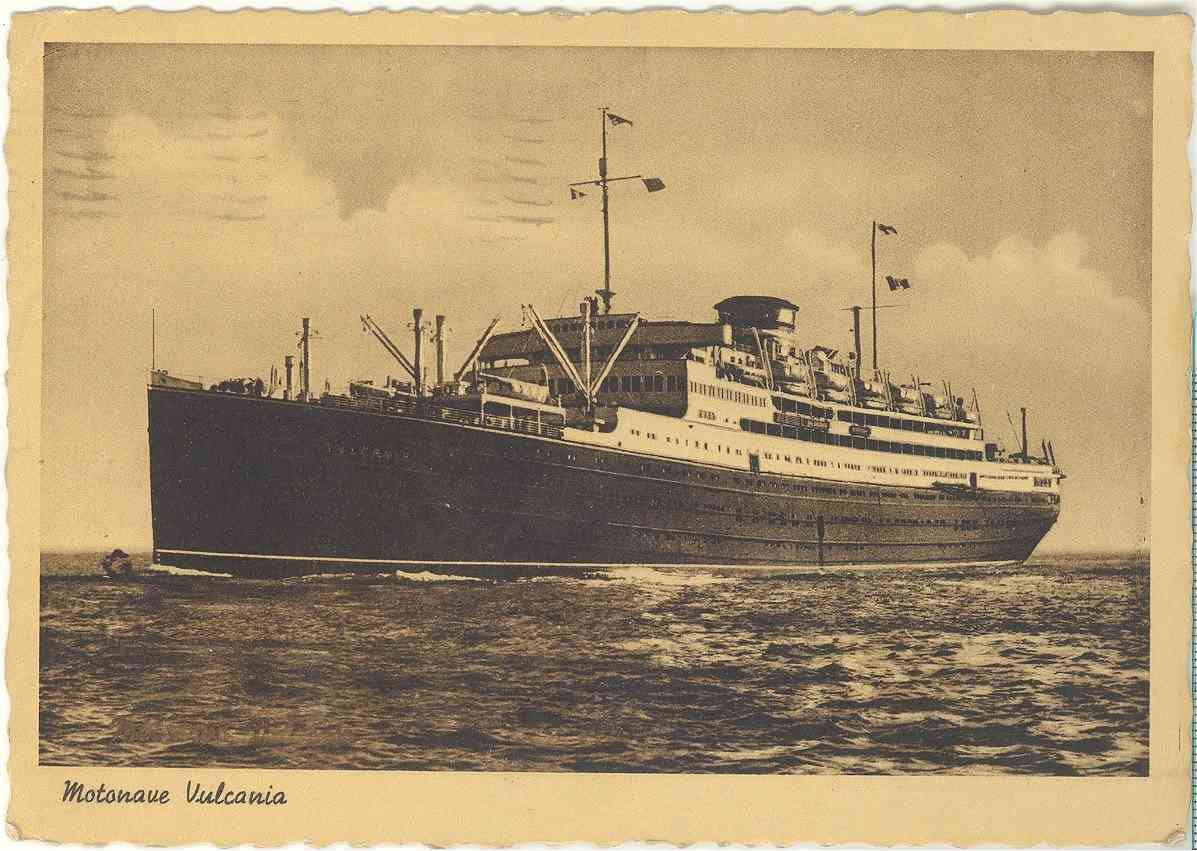
The MS Vulcania was an Italian ocean liner constructed in 1926 by Cantiere Navale Triestino in Monfalcone, Italy. She was one of the most successful passenger ships of her era, notable for her large size and innovative features. With a gross register tonnage of approximately 23,970 GRT, she measured 192.92 meters in length and 24.23 meters in breadth. The vessel was powered by a large two-stroke diesel engine, one of the largest of its time, featuring double-acting cylinders and a crosshead, enabling her to reach a maximum speed of 19 knots initially, later improved to 21 knots after engine upgrades in 1930. Vulcania’s design included a single funnel, two masts, and twin screws. Her passenger accommodations were extensive, with capacity for 310 first class, 460 second class, 310 intermediate, and 700 third class passengers, although her configuration was modified over the years to include tourist and other classes. She was among the first liners to feature cabins with private balconies, a significant innovation at the time, with interior decor designed by Casa Artistica in a conservative classical style, complemented by artworks like Marcello Mascherini’s 1934 bas-relief "Le Sirene". Launched on December 18, 1926, Vulcania embarked on her maiden voyage to New York in December 1928. She served as a transatlantic liner, making numerous voyages between Europe and the Americas, including stops in Palestine and South America. She was requisitioned by the Italian government for wartime duties, transporting troops during the Second Italo-Ethiopian War and later serving as a troopship during World War II. In 1940, she made a notable voyage to South America, evading British patrols. Post-war, Vulcania resumed passenger service, including runs for American Export Lines and her final years operating in the Mediterranean. Sold in 1965 to Sicula Oceanica, she was renamed Caribia and used as an immigrant and cruise ship until her sinking in 1973 after hitting a rock off Cannes. Her long and varied career highlights her importance as a pioneering and versatile vessel in maritime history.
This description has been generated using GPT-4.1-NANO based on the Vessel's wikidata information and then modified by ShipIndex.org staff.