
Japanese cruiser Kasuga
1902 Kasuga-class cruiser
Vessel Wikidata
* This information from Wikidata is available under the Creative Commons Attribution-ShareAlike License
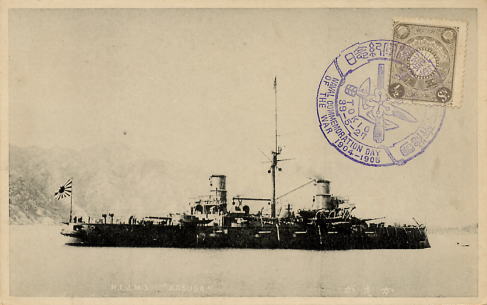
The Japanese cruiser Kasuga was the lead ship of the Kasuga-class armored cruisers of the Imperial Japanese Navy, constructed in the early 1900s by Gio. Ansaldo & C. in Italy. Originally ordered by the Royal Italian Navy as Mitra in 1901, she was sold in 1902 to the Argentine Navy and renamed Bernardino Rivadavia. However, due to changing political and financial circumstances, she was sold before delivery to Japan, which purchased her amid rising tensions with Russia. Kasuga measured approximately 111.73 meters (366 ft 7 in) in length, with a beam of 18.71 meters (61 ft 5 in) and a draft of 7.31 meters (24 ft 0 in). She displaced about 7,700 metric tons at normal load. Her propulsion system consisted of two vertical triple-expansion steam engines powered by eight coal-fired Scotch marine boilers, designed to produce 13,500 indicated horsepower, enabling her to reach a top speed of just over 20 knots, specifically 20.05 knots during sea trials. She had a cruising range of 5,500 nautical miles at 10 knots and a crew complement of around 560 officers and men. Her armament included a main battery of one 10-inch (254 mm) gun in a forward turret and two 8-inch (203 mm) guns in a twin turret aft. Her secondary armament comprised ten 6-inch (152 mm) quick-firing guns, with additional smaller caliber guns for defense against torpedo boats, and four submerged 18-inch (460 mm) torpedo tubes. Armor protection featured a waterline belt up to 150 mm thick amidships, tapering towards the ends, and armored turrets and conning towers with 150 mm of armor. Kasuga participated prominently in the Russo-Japanese War, engaging in the Battle of the Yellow Sea and the Battle of Tsushima, where she notably fired on Russian ships and contributed to Japanese victories. She also took part in bombardments of Port Arthur and the invasion of Sakhalin. After her wartime service, Kasuga served in various roles, including convoy escort during World War I and as a flagship for destroyer squadrons. She also undertook diplomatic visits to the United States and was involved in rescue operations, such as saving crews from stranded ships. In the late 1920s and 1930s, Kasuga transitioned to a training vessel role before being disarmed and hulked in 1942, serving as a barracks ship. She capsized at Yokosuka during an air raid in 1945, was salvaged in 1948, and subsequently broken up for scrap. Her service history underscores her importance in Japan’s early 20th-century naval development and her active participation in key naval battles of the Russo-Japanese War.
This description has been generated using GPT-4.1-NANO based on the Vessel's wikidata information and then modified by ShipIndex.org staff.