
RMS Saxonia
Cunard Line ship built in 1900
Vessel Wikidata
* This information from Wikidata is available under the Creative Commons Attribution-ShareAlike License
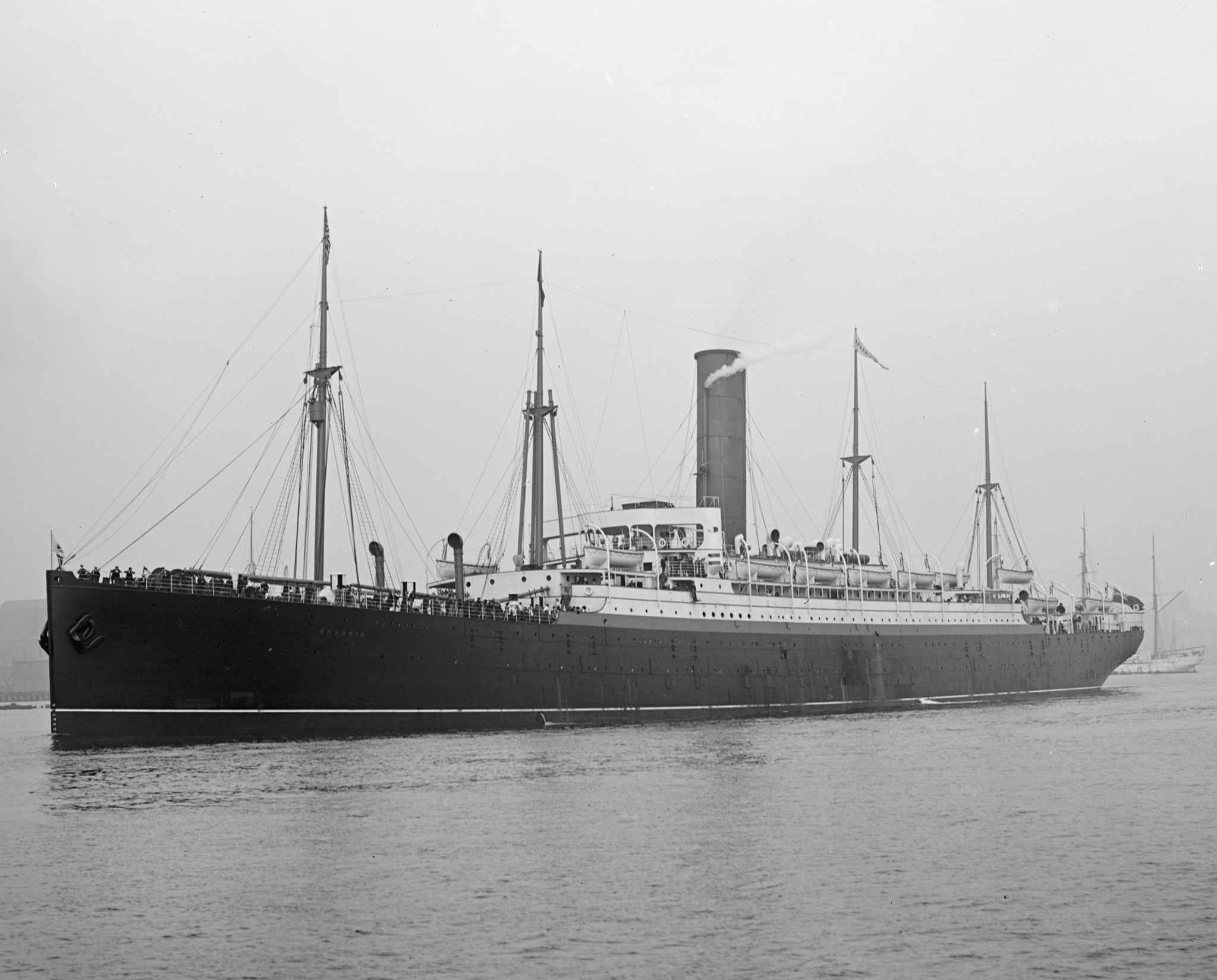
The RMS Saxonia was a British Cunard Line passenger vessel launched on December 16, 1899, at the John Brown & Company shipyard in Clydebank, Scotland. As the second and largest ship of the Ivernia class of intermediate liners, she measured 14,281 gross register tons (GRT), making her the biggest Cunard liner up to that time, surpassing even her sister ship RMS Ivernia. Her design featured a long, black hull with a low, well-balanced superstructure and four masts, which were primarily used for cargo handling rather than traditional sailing purposes. Power was provided by twin quadruple expansion steam engines driving two propellers, enabling her to reach a service speed of approximately 15 knots. Constructed primarily for profitability amidst fierce competition from White Star and German lines, Saxonia prioritized cargo capacity, which limited her passenger accommodations compared to her size. She was equipped with substantial cargo holds, and her four masts allowed for effective cargo management. Fitting out was completed by mid-May 1900, and she embarked on her maiden voyage from Liverpool to Boston on May 22, 1900. Her initial service route was between Liverpool and Boston, later alternating between Boston and New York, and between Liverpool and Adriatic ports such as Fiume and Trieste. During World War I, Saxonia was requisitioned for military service. She made a troopship voyage carrying Canadian soldiers and served as an accommodation ship for German prisoners in England. After the war, she resumed commercial service, primarily on North Atlantic routes. Notably, on April 17, 1919, her propeller struck the U.S. Navy tug USS Freehold, causing the latter to sink with one fatality. In 1920, the vessel underwent a significant refit at Tilbury, which included shortening her funnel, modifying her passenger facilities to carry 1,449 passengers, and reducing her gross tonnage slightly to 14,197 GRT. She continued her North Atlantic service, with an additional stop at Hamburg added later. By 1925, Saxonia was considered outdated and was sold for scrap to a Dutch company, with her scrapping completed before the end of that year.
This description has been generated using GPT-4.1-NANO based on the Vessel's wikidata information and then modified by ShipIndex.org staff.