
HMS Newfoundland
1941 Crown Colony-class light cruiser
Vessel Wikidata
* This information from Wikidata is available under the Creative Commons Attribution-ShareAlike License
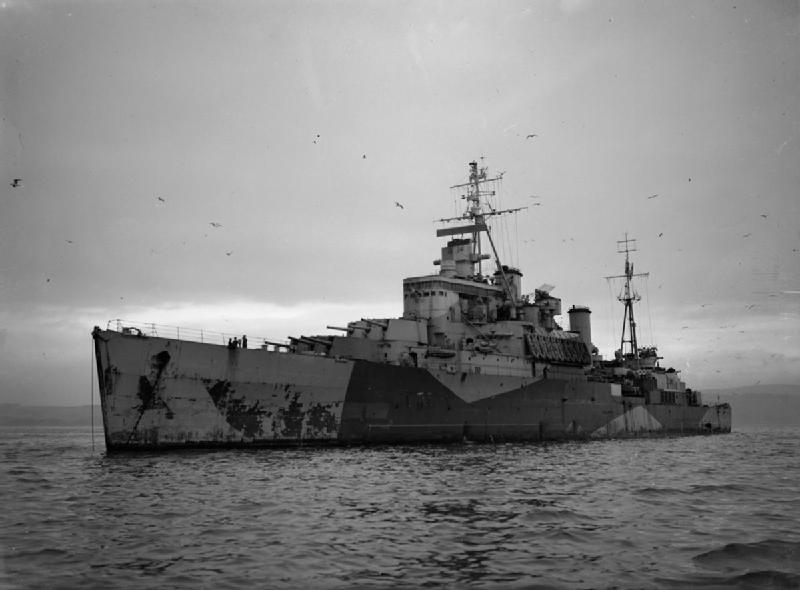
HMS Newfoundland was a Fiji-class light cruiser of the Royal Navy, launched on 19 December 1941 by Swan Hunter. Completed in December 1942 and commissioned the following month, she measured approximately 555 feet in length with a beam of around 56 feet, typical of her class. Her armament included twin 6-inch guns, 40mm anti-aircraft mounts, and torpedo tubes, making her a versatile combat vessel. Initially joining the 10th Cruiser Squadron of the Home Fleet, Newfoundland soon became flagship of the 15th Cruiser Squadron in the Mediterranean. During the Sicily Campaign in July 1943, she provided crucial support for the 1st Parachute Brigade during the attack on Primasole Bridge. On 23 July 1943, she was torpedoed—either by the Italian submarine Ascianghi or the German U-407—resulting in the loss of one crew member and damage to her rudder. Temporary repairs in Malta and jury-rigged steering methods allowed her to reach Boston Navy Yard for comprehensive repairs. In 1944, she was re-commissioned for service in the Far East. An explosion in her torpedo tubes in Alexandria caused damage and delayed her deployment. She participated in operations supporting Australian forces in New Guinea and attacked Truk in June 1945 during Operation Inmate. Newfoundland also took part in the bombardment of Kamaishi and the capture of Yokosuka, and was present in Tokyo Bay for the surrender of Japan on 2 September 1945. Post-war, she was tasked with repatriating prisoners of war before returning to Britain in December 1946. Remaining initially in reserve, Newfoundland was used as a training ship and underwent an extensive modernization starting in 1951, which included new electrical and fire control systems, a new bridge, and lattice masts for advanced radar. Recommissioned in November 1952, she served as flagship of the 4th Cruiser Squadron in the East Indies, participating in regional events such as the Hartal of 1953 in Sri Lanka. During her service in the Far East, she engaged in military actions, notably sinking the Egyptian frigate Domiat in 1956 amid the Suez Crisis, and supporting British operations in Malaya. Decommissioned in 1959, she was sold to the Peruvian Navy, renamed Almirante Grau, and later Capitán Quiñones, serving as a static training ship until her scrapping in 1979.
This description has been generated using GPT-4.1-NANO based on the Vessel's wikidata information and then modified by ShipIndex.org staff.