
USS Wisconsin
1898 Illinois-class battleship
Vessel Wikidata
* This information from Wikidata is available under the Creative Commons Attribution-ShareAlike License
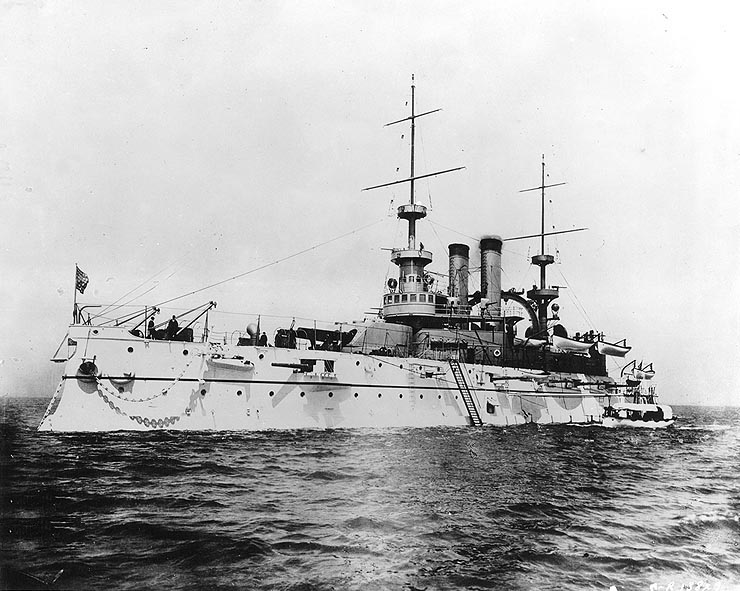
USS Wisconsin (BB-9) was an Illinois-class pre-dreadnought battleship and the first U.S. Navy vessel named for the 30th state. Constructed at Union Iron Works in San Francisco, her keel was laid in February 1897, and she was launched in November 1898. She was commissioned in February 1901, measuring approximately 374 feet in length with a beam of 72 feet 3 inches and a draft of 23 feet 8 inches. Her displacement was around 11,653 long tons designed, reaching up to 12,250 long tons at full load. Powered by two triple-expansion steam engines and eight coal-fired boilers, she could reach a top speed of 16 knots. Wisconsin’s armament included four 13-inch (330 mm)/35 caliber guns in twin turrets, fourteen 6-inch (152 mm)/40 caliber guns in casemates, and a secondary anti-torpedo boat battery of sixteen 6-pounder guns and six 1-pounder guns. She was also equipped with four 18-inch torpedo tubes. Her armor was formidable for her time, with a main belt up to 16.5 inches thick over vital spaces, and main gun turrets protected by 14-inch armor. Initially serving as the flagship of the Pacific Fleet, Wisconsin undertook a long-distance cruise to American Samoa in 1901. In 1903, she transferred to the Asiatic Fleet, serving as the Northern Squadron flagship off China and Japan, visiting numerous East Asian ports. She rejoined the U.S. fleet in 1906, participating in the second leg of the Great White Fleet’s global cruise from late 1908 to early 1909, a symbol of American naval power and diplomacy. After extensive overhauls and serving in various fleet activities, Wisconsin was placed in reserve in 1910 and later used as a training ship, particularly for Naval Academy cadets. During World War I, she was assigned to the Coast Battleship Patrol Squadron and participated in training and patrol duties, but saw no combat. Decommissioned in 1920 and reclassified as BB-9, she was sold for scrap in 1922, marking the end of her maritime service. Her career reflects early 20th-century naval strategy and the evolution of American battleship design.
This description has been generated using GPT-4.1-NANO based on the Vessel's wikidata information and then modified by ShipIndex.org staff.