
HMS Hogue
1900 Cressy-class armored cruiser
Vessel Wikidata
* This information from Wikidata is available under the Creative Commons Attribution-ShareAlike License
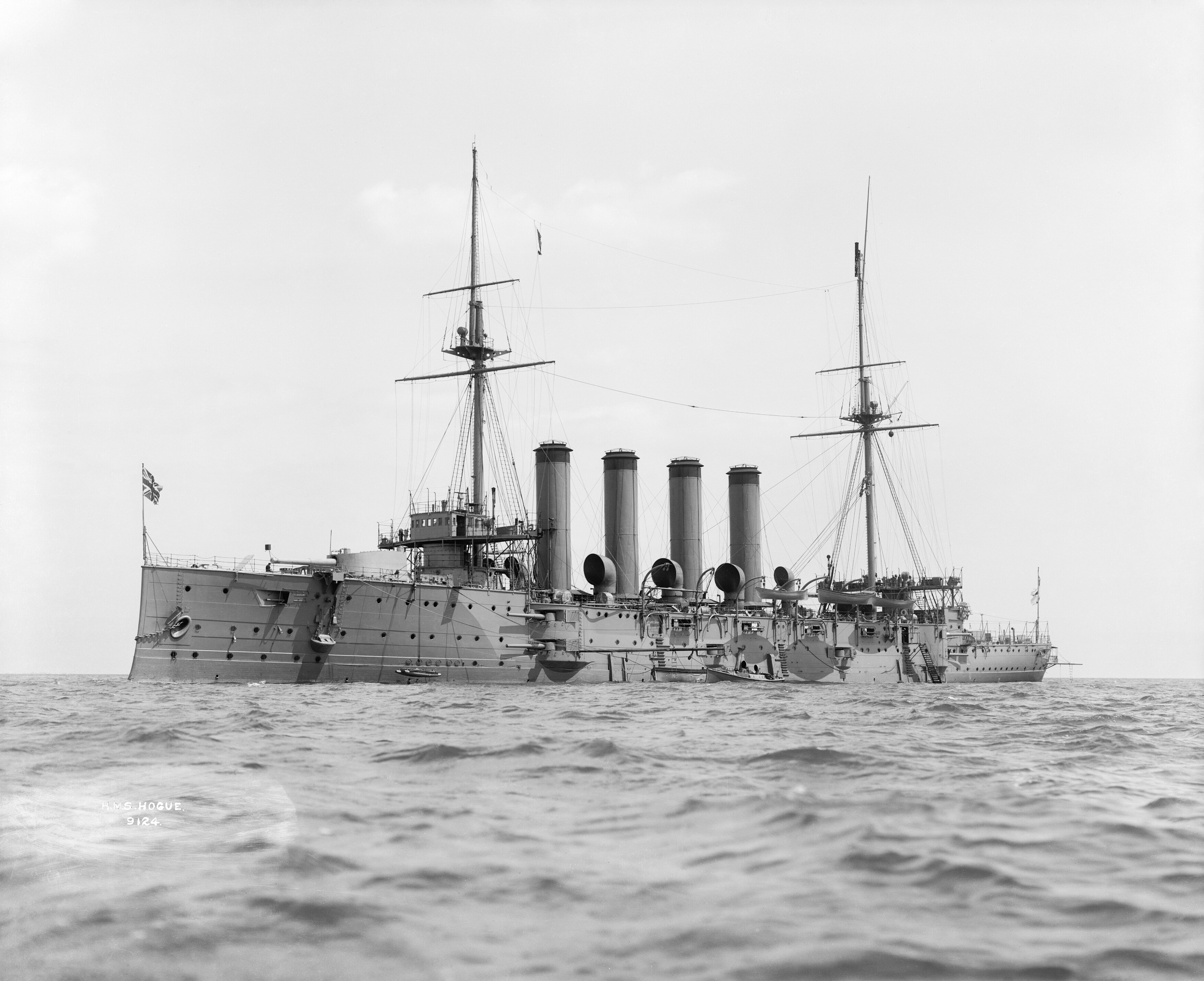
HMS Hogue was a Cressy-class armoured cruiser built for the Royal Navy around 1900, distinguished by its substantial size and armament. Displacing approximately 12,000 long tons, she measured 472 feet in length with a beam of 69 feet 6 inches and a deep draught of 26 feet 9 inches. Her propulsion system consisted of two 4-cylinder triple-expansion steam engines, delivering a total of 21,000 indicated horsepower via 30 Belleville boilers, which enabled her to reach a maximum speed of around 22 knots, exceeding her design specification. The ship carried a maximum of 1,600 long tons of coal and had a crew complement of approximately 725 to 760 officers and ratings. HMS Hogue's main armament included two 9.2-inch breech-loading guns mounted in single turrets fore and aft, capable of firing shells weighing 380 pounds to a range of 15,500 yards. Her secondary armament comprised twelve 6-inch guns housed in casemates amidships, with eight on the main deck suitable only for calm weather, and twelve 12-pounder quick-firing guns for defense against torpedo boats. Additional armaments included three 3-pounder Hotchkiss guns and two submerged 18-inch torpedo tubes. The ship's armor scheme featured a waterline belt up to 6 inches thick, with gun turrets and barbettes protected by 6 inches of armor, casemate armor at 5 inches, and a protective deck varying from 1 to 3 inches. The conning tower was heavily armored with 12 inches. Laid down on 14 July 1898 by Vickers, Sons & Maxim at Barrow-in-Furness, HMS Hogue was launched on 13 August 1900 and completed in late 1902. Her early service included assignments to the Channel Squadron and the China Station, with notable activities such as a cruise visiting European ports and a collision with the merchant ship SS Meurthe in 1904. She later served as a boys' training ship and was reduced to reserve in 1908. Recommissioned at the outbreak of World War I in 1914, HMS Hogue participated in patrols in the North Sea supporting the Harwich Force. Her most notable and tragic engagement occurred on 22 September 1914, during which she, along with her sister ships Aboukir and Cressy, was attacked by the German submarine U-9. Despite lookouts and defensive measures, U-9 torpedoed Hogue, causing her to capsize and sink with the loss of 377 men. This event marked one of the early and significant submarine successes of the war, highlighting the evolving nature of naval warfare.
This description has been generated using GPT-4.1-NANO based on the Vessel's wikidata information and then modified by ShipIndex.org staff.