
HMS Thrush
1889 Redbreast-class gunboat
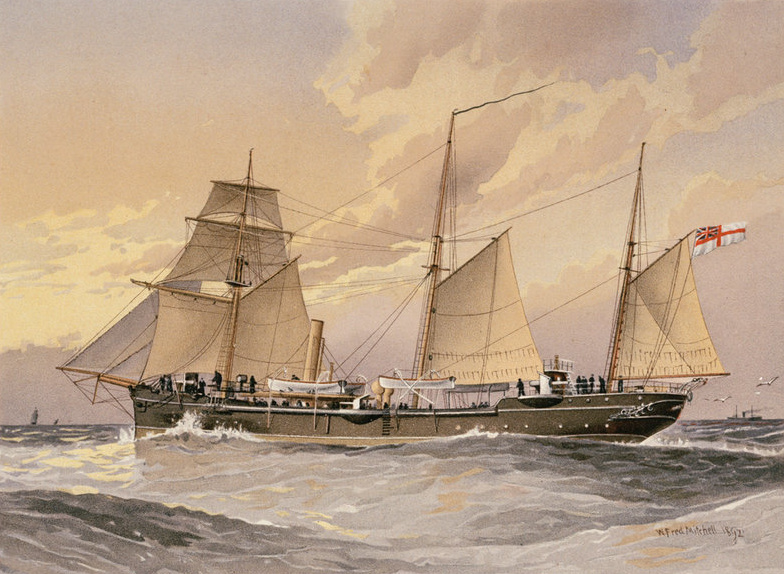
Vessel Wikidata
* This information from Wikidata is available under the Creative Commons Attribution-ShareAlike License
HMS Thrush was a Redbreast-class composite gunboat constructed for the Royal Navy, launched on 22 June 1889 at Greenock. Designed by Sir William Henry White, the vessel featured a composite build, combining iron frames with wooden planking, typical of the class. Powered by a triple-expansion reciprocating steam engine manufactured by the Greenock Foundry, Thrush generated 1,200 indicated horsepower, enabling a maximum speed of 13 knots through a single screw propeller. Her initial deployment was on the North America and West Indies Station, based at the Royal Naval Dockyard in Bermuda and Halifax, Nova Scotia. Notably, she arrived in Bermuda on 18 July 1890 under the command of Prince George, later King George V, towing a torpedo boat. During her service, she participated in notable operations, including the 40-minute Anglo-Zanzibar War in 1896 alongside her sister ship Sparrow. She also served during the Second Boer War (1899–1902), with Lieutenant Warren Hastings D'Oyly commanding her during this period. In 1902, she assisted British efforts in Nigeria by helping reopen trade routes on the Lower Niger, which had been disrupted by local piracy. Lieutenant Hector Lloyd Watts-Jones took command in July 1902. From 1906, HMS Thrush was repurposed for service with HM Coastguard, and in 1915, she transitioned to a cable ship before becoming a salvage vessel in 1916. A significant event in her later career was her involvement in the rescue operation of 46 submariners and shipyard officials from the sunken HMS K13 in January 1917. During trials, K13 had catastrophically sank in the Gareloch; Thrush, along with Gossamer and Ranger, helped partially raise the submarine with cables, saving many lives. HMS Thrush met her end off Glenarm, Northern Ireland, on 11 April 1917, wrecked during a snowstorm. Her scattered remains were discovered in 1969 by divers, lying about 50 yards offshore at depths of 30–40 feet. Her varied service history and involvement in notable events highlight her maritime significance in late 19th and early 20th-century naval operations.
This description has been generated using GPT-4.1-NANO based on the Vessel's wikidata information and then modified by ShipIndex.org staff.