
SS Komagata Maru
Japanese cargo ship in service 1924-26
Vessel Wikidata
* This information from Wikidata is available under the Creative Commons Attribution-ShareAlike License
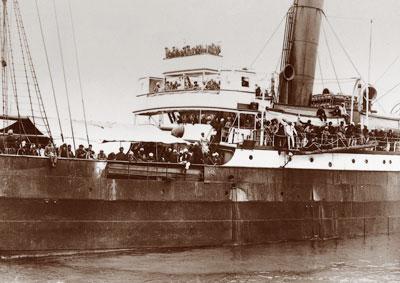
The SS Komagata Maru was a cargo steamship originally built in Scotland in 1890 by Charles Connell and Company of Scotstoun, Glasgow. Constructed as part of a pair of ships, she was launched as Stubbenhuk on 20 May 1890, with a sister ship named Grimm. She measured approximately 329 feet (100 meters) in length, with a beam of 41.5 feet (12.6 meters) and a depth of 25.8 feet (7.9 meters). Her gross register tonnage was 2,943 GRT, and she had a net tonnage of 1,921 NRT. The vessel was primarily a cargo carrier but was equipped with berths for a small number of passengers. Power was provided by a three-cylinder triple-expansion steam engine built by David Rowan & Co of Glasgow, rated at 288 NHP, enabling her to reach speeds of up to 11 knots (20 km/h). She was fitted with a single screw propeller. Initially registered in Hamburg, she was operated by Dampfschiffs Rhederei "Hansa," serving routes between Hamburg, Canada, and the United States. Her maiden voyage commenced on 19 October 1890, heading to Quebec and Montreal. In 1892, Hamburg America Line (HAPAG) took over her company, and she was renamed Scotia, later becoming Sicilia in 1894 after the fleet's absorption into HAPAG. By 1913, she was purchased by Japanese owners, Shinyei Kisen Goshi Kaisha, and renamed Komagata Maru, registering in Dairen in the Japanese-ruled Kwantung Leased Territory. She is notably known for her 1914 voyage when she was chartered to carry Sikh migrants from Hong Kong, Shanghai, Moji, and Yokohama to Vancouver. During this voyage, she was renamed Guru Nanak Jahaz, and her holds were adapted for passenger comfort. The vessel's most historically significant event occurred when she arrived in Vancouver with 376 migrants, only 24 of whom were permitted to disembark, leading to the infamous Komagata Maru incident. Throughout her later years, the ship changed ownership multiple times, being registered in Fusan, Nishinomiya, and Osaka under different Japanese companies, and renamed Heian Maru in 1924. She was eventually wrecked near Cape Sotomari on 11 February 1926 while steaming along Hokkaido’s coast. The SS Komagata Maru remains a vessel of maritime and historical significance, especially for its association with the migrant voyage and the broader story of immigration restrictions in the early 20th century.
This description has been generated using GPT-4.1-NANO based on the Vessel's wikidata information and then modified by ShipIndex.org staff.