
HMS Partridge
1941 O and P-class destroyer
Vessel Wikidata
* This information from Wikidata is available under the Creative Commons Attribution-ShareAlike License
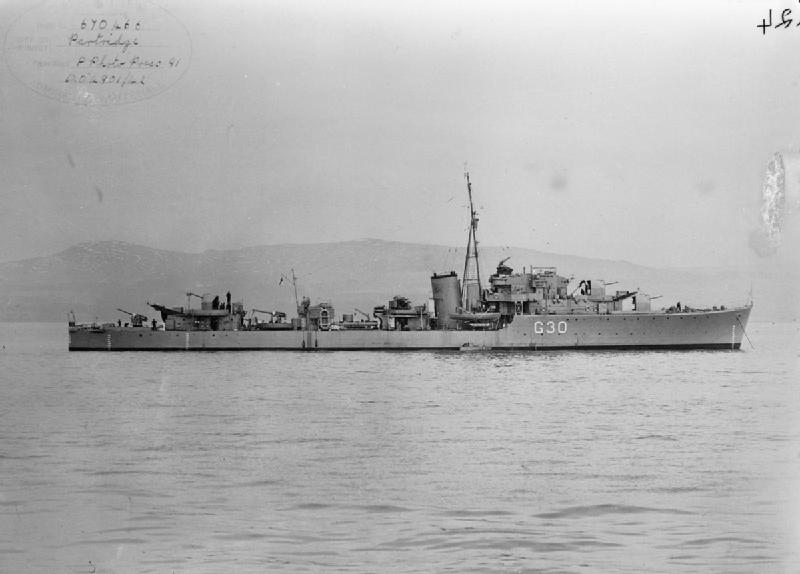
HMS Partridge was a P-class destroyer of the Royal Navy, constructed during the early years of World War II. Built by the Fairfield Shipbuilding and Engineering Company at Govan, Scotland, she was laid down on 3 June 1940, launched on 5 August 1941, and completed on 22 February 1942. The vessel measured 345 feet in overall length, with a beam of 35 feet and a draught of 9 feet (mean) at standard displacement, which was approximately 1,550 long tons. Fully loaded, her displacement increased to about 2,250 long tons. She was powered by two Admiralty three-drum boilers feeding Parsons steam turbines, rated at 40,000 shp, enabling a maximum speed of roughly 36.75 knots. The ship's armament comprised five 4-inch (102 mm) QF Mark V anti-aircraft guns in single mounts, supplemented by close-in anti-aircraft weapons including a quadruple 2-pounder "pom-pom" mount and four single Oerlikon 20 mm cannons. She also carried a single quadruple 21-inch torpedo tube set and was equipped with four depth charge throwers, carrying 70 depth charges for anti-submarine warfare. HMS Partridge served primarily in the Mediterranean, participating in pivotal convoy operations to Malta, including Operation Harpoon in June 1942. During this convoy, she engaged Italian naval forces, was hit three times by Italian shells, and was temporarily immobilized due to engine damage but managed to reach Gibraltar. After repairs, she supported convoy escort duties to Sierra Leone and participated in Operation Torch, the Allied invasion of French North Africa. On 18 December 1942, while on anti-submarine patrol west of Oran, she was torpedoed and sunk by the German U-boat U-565, resulting in the loss of 37 crew members, with 173 survivors rescued by her sister ship Penn. HMS Partridge's service exemplifies the vital role of destroyers in Mediterranean convoy battles and anti-submarine warfare during the early years of the war, highlighting her as a capable and resilient vessel within the Royal Navy's wartime fleet.
This description has been generated using GPT-4.1-NANO based on the Vessel's wikidata information and then modified by ShipIndex.org staff.