
HMS Glory
1788 Duke-class second-rate ship of the line
Vessel Wikidata
* This information from Wikidata is available under the Creative Commons Attribution-ShareAlike License
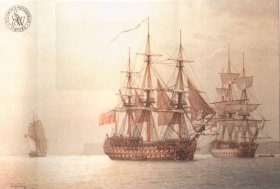
HMS Glory was a 98-gun second-rate ship of the line of the Royal Navy, launched on 5 July 1788 at Plymouth. As a second-rate vessel, she was among the larger ships designed for line-of-battle tactics, equipped with a formidable armament of 98 guns, which would have made her a significant force during her service. Constructed at Plymouth, HMS Glory served during the late 18th and early 19th centuries, a period marked by the Napoleonic Wars and widespread naval conflicts. Notably, in 1798, her crew faced disciplinary issues when some members were court-martialed for mutiny, reflecting the challenges faced aboard ships of this era. On 11 March 1805, HMS Glory played a role in the naval operations off Cadiz, where Vice Admiral Sir John Orde, aboard the vessel, notified the U.S. Consul that Cadiz was under blockade, indicating her involvement in blockade tactics against enemy ports. During the Battle of Cape Finisterre in 1805, she served as the flagship of Rear-Admiral Sir Charles Stirling, under the command of Captain Samuel Warren. This engagement was part of the broader naval efforts during the Napoleonic Wars and underscored her importance as a command ship. In September 1809, HMS Glory was re-rated as a prison ship at Chatham, a common fate for aging warships. Lieutenant Richard Simmonds commanded her in 1810 and 1811, later succeeded by Lieutenant Robert Tyte and Vice Admiral George Murray in 1794. She was paid off into ordinary in August 1814, ending her active service. From 1815, she was repurposed as a powder hulk, serving as a static storage vessel for gunpowder. Eventually, her decommissioning was finalized when she was ordered to be broken up in 1819, with the process completed at Chatham on 30 July 1825. HMS Glory's career reflects the typical lifecycle of a prominent Royal Navy ship of her era, transitioning from active combat to auxiliary roles before dismantling.
This description has been generated using GPT-4.1-NANO based on the Vessel's wikidata information and then modified by ShipIndex.org staff.