
USS Walke
1910 Paulding-class destroyer
Vessel Wikidata
* This information from Wikidata is available under the Creative Commons Attribution-ShareAlike License
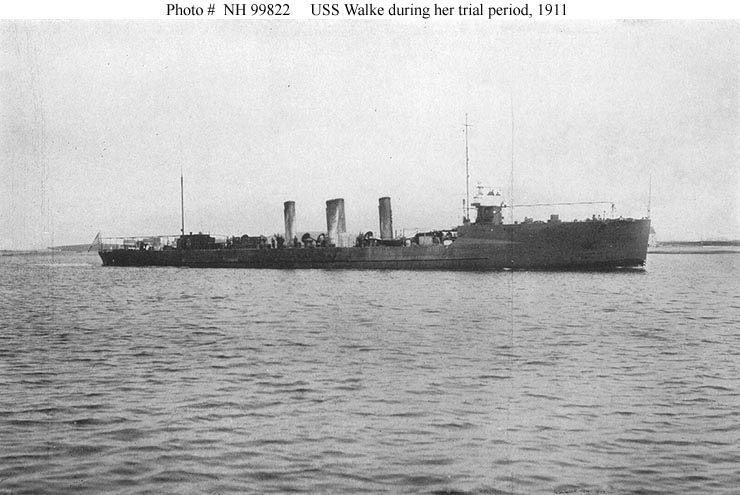
The USS Walke (DD-34) was a Paulding-class destroyer constructed for the United States Navy, embodying early 20th-century naval design focused on speed, agility, and torpedo capabilities. Laid down on March 5, 1910, at the Fore River Shipbuilding Company in Quincy, Massachusetts, she was launched on November 3, 1910, and commissioned on July 22, 1911, at the Boston Navy Yard. The vessel was named after Rear Admiral Henry A. Walke and was designated DD-34 after July 17, 1920. Physically, she was typical of the Paulding class, designed for fleet screening, with a hull suitable for swift maneuvering and armed primarily with torpedoes and guns for offensive and defensive operations. During her early service, she was assigned to the Atlantic Torpedo Fleet's 9th Division, conducting training exercises along the Atlantic coast from Cape Cod to Cuba, including battle practice and torpedo-firing drills. From 1913, she was placed in reserve at the New York Navy Yard but retained a partial crew to maintain her machinery. Notably, in late 1914, she participated in experimental deep-sea diving trials, including a record-depth dive by Navy diver Stephen J. Drelishak. Rejoining active service in 1915, Walke engaged in various peacetime activities, including national celebrations and fleet maneuvers. In 1916, she supported U.S. efforts to restore order during revolutionary unrest in the Dominican Republic, cruising along Hispaniola and visiting nearby ports. With the advent of World War I, Walke was overhauled and prepared for wartime patrols. She departed the U.S. in May 1917, arriving in European waters by June, where she patrolled the western approaches of Ireland and France, hunting U-boats and escorting convoys. Due to limited fuel capacity, initial transatlantic crossings were made under tow. After the war, she continued coastwise operations and fleet exercises along the U.S. Atlantic coast. Decommissioned on December 12, 1919, Walke remained at the Philadelphia Navy Yard until her scrapping in April 1935, following her strike from the Naval Vessel Register. Her service highlights her role in early naval tactics, naval diplomacy, and convoy escort during World War I, marking her as a significant vessel in the evolution of U.S. destroyer operations.
This description has been generated using GPT-4.1-NANO based on the Vessel's wikidata information and then modified by ShipIndex.org staff.