
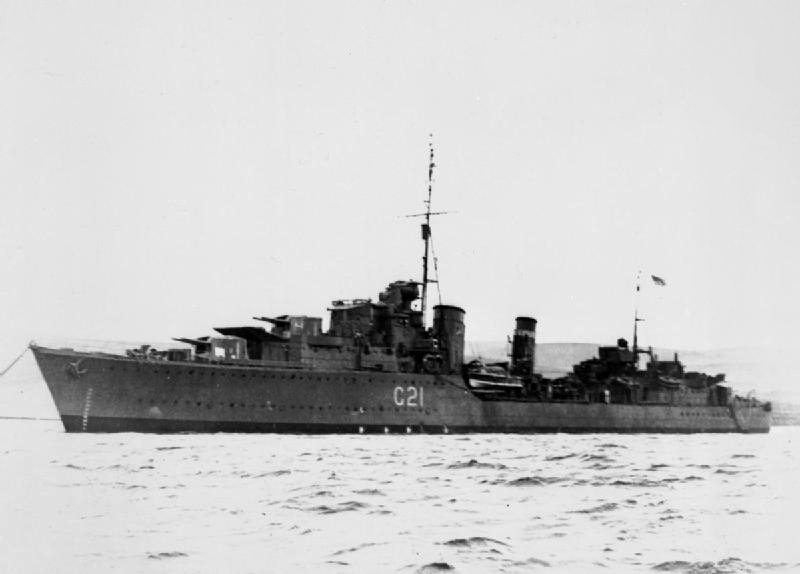
HMS Punjabi
1937 Tribal-class destroyer
Vessel Wikidata
* This information from Wikidata is available under the Creative Commons Attribution-ShareAlike License
HMS Punjabi was a Tribal-class destroyer of the Royal Navy, commissioned in 1939 and serving prominently during the Second World War. As a Tribal-class vessel, she was designed to be larger and more heavily armed than previous destroyers, with a standard displacement of approximately 1,891 long tons and a deep load displacement of around 2,519 long tons. Her overall length was 377 feet, with a beam of 36 feet 6 inches, and a draught of 11 feet 3 inches. Powered by two Parsons geared steam turbines driving four shafts, she was capable of reaching speeds up to 36 knots, with her sea trials recording a maximum of 36.0 knots. Her fuel capacity enabled a range of about 5,700 nautical miles at 15 knots. Punjabi's armament comprised eight 4.7-inch (120 mm) QF Mark XII guns in four superfiring twin mounts, with additional anti-aircraft defenses including a quadruple 40 mm "pom-pom" gun and two quadruple 0.5-inch machine gun mounts. She was equipped with a single 21-inch torpedo tube mount and had some anti-submarine weaponry, including ASDIC, depth charges, and throwers, totaling up to 30 depth charges during wartime. Over her service, her anti-aircraft armament was upgraded, notably replacing her 'X' mount with twin 4-inch guns and installing radar systems for better gunnery control. Constructed by Scotts Shipbuilding & Engineering in Greenock, she was laid down on June 9, 1936, launched on October 1, 1936, and commissioned on March 29, 1939, costing £342,005 excluding weaponry supplied by the Admiralty. Her operational career included duties in the Home Fleet, anti-submarine patrols, convoy escort, and participation in notable engagements such as the Second Battle of Narvik. She was involved in various rescue and escort missions, including evacuations from Saint-Nazaire and Polish troops, and supported Allied operations in the Norwegian campaign. Tragically, HMS Punjabi was sunk on May 1, 1941, in a collision with the battleship HMS King George V in foggy conditions during convoy operations. While maneuvering in heavy fog, a lookout believed to have spotted a mine, prompting an emergency turn that led to the destroyer being sliced in two by the battleship’s bow. Of her crew, 49 were lost, with the rest rescued. The sinking marked a significant loss for the Royal Navy's wartime destroyer force.
This description has been generated using GPT-4.1-NANO based on the Vessel's wikidata information and then modified by ShipIndex.org staff.