
HMS Black Prince
1942 Dido-class light cruiser
Vessel Wikidata
* This information from Wikidata is available under the Creative Commons Attribution-ShareAlike License
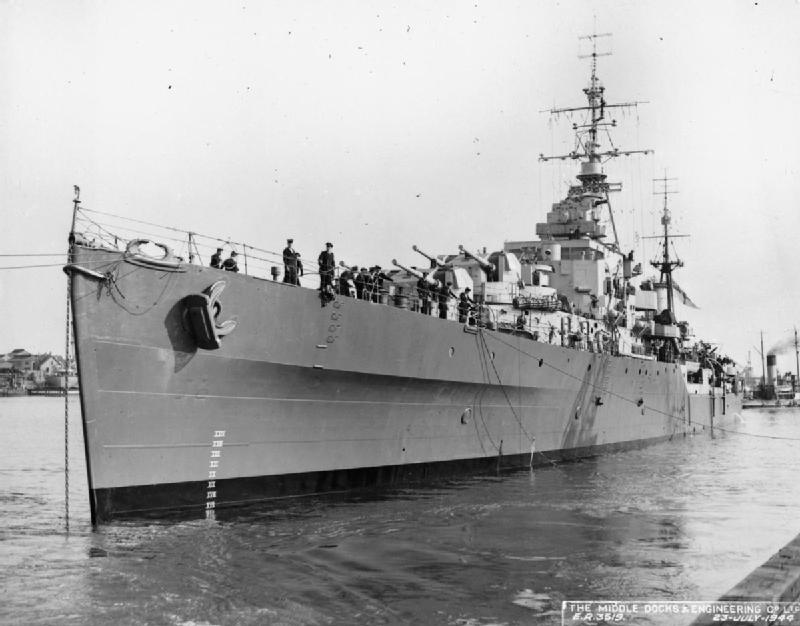
HMS Black Prince was a Dido-class light cruiser of the Royal Navy, specifically part of the Bellona subgroup, built by Harland & Wolff in Belfast. Her keel was laid on 2 November 1939, and she was launched on 27 August 1942, completing construction on 20 November 1943. The vessel was a modified Dido design, often called Dido Group 2, featuring only four 5.25-inch gun mounts instead of five, and enhanced anti-aircraft armament, including a single quad "pom pom" and eight Mk3 40mm Bofors guns after her modernization. Commissioned in 1943, Black Prince served prominently during World War II, participating in Arctic convoy operations and offensive sweeps along the German coast. Notably, in April 1944, she was involved in an engagement off Brittany that resulted in the sinking of the torpedo boat T29 and damage to others. During the Normandy invasion, she supported Utah Beach as part of Force "A" of Task Force 125, which included battleships, cruisers, and destroyers. Her targets included German coastal batteries, such as at Morsalines. Later, she participated in the Mediterranean invasion of Southern France and operated in the Aegean Sea, bombarding German airfields in Crete. In late 1944, Black Prince moved to the Indian Ocean and the Far East, arriving in Colombo to support operations against Japanese-held territories, including raids on Sumatra and Malaya. She also saw action off Okinawa and participated in final bombardments of Japan before returning to Hong Kong in September 1945. In 1946, Black Prince was loaned to the Royal New Zealand Navy, becoming HMNZS Black Prince. A planned modernisation in 1947 was canceled following mutinies among her crew, leading to her being placed in reserve. She was reactivated in 1952 with simplified armament and participated in the 1953 Coronation Fleet Review. Decommissioned again in 1955, she was used as an accommodation and support vessel until her final disposal. Sold for scrap in 1962, she was towed from Auckland to Japan for breaking up. Her service marked her as a notable vessel in wartime operations and post-war naval history.
This description has been generated using GPT-4.1-NANO based on the Vessel's wikidata information and then modified by ShipIndex.org staff.