
HMS Dasher
1941 Avenger-class escort carrier
Vessel Wikidata
* This information from Wikidata is available under the Creative Commons Attribution-ShareAlike License
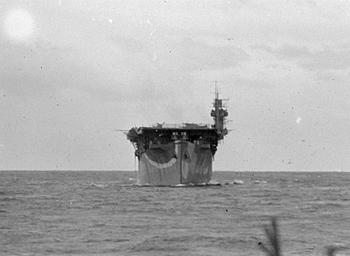
HMS Dasher (D37) was a British Royal Navy escort aircraft carrier of the Avenger class, originally constructed as a U.S. Maritime Commission type C3 merchant ship named Rio de Janeiro. Built by the Sun Shipbuilding and Drydock Company in Chester, Pennsylvania, she was laid down on 14 March 1940, launched on 11 April 1941, and initially intended for passenger and cargo service with Moore-McCormack Lines. She was converted into an escort carrier at the Tietjen & Lang shipyards in New Jersey and commissioned into the Royal Navy on 2 July 1942. Physically, HMS Dasher measured approximately 492 feet 3 inches (150.04 meters) in length, with a beam of 66 feet 3 inches (20.19 meters) and a draught of 23 feet 3 inches (7.09 meters). She displaced about 8,200 long tons at normal load, increasing to 9,000 long tons at deep load. Powered by four diesel engines linked to a single shaft, she could reach speeds of 16.5 knots. Her flight deck was 410 feet (120 meters) long with a small combined bridge-flight control on the starboard side, a single aircraft lift, a catapult, and nine arrestor wires. She could carry up to 15 aircraft, including fighters like the Grumman Martlet or Hawker Sea Hurricane and torpedo bombers like the Fairey Swordfish, housed in a below-deck hangar. During her service, HMS Dasher participated in Operation Torch and conducted aircraft ferry duties in the Mediterranean. In March 1943, after her flight deck was extended by 42 feet (13 meters), she embarked Fairey Swordfish aircraft. Her operational history was cut short when she suffered an internal explosion shortly after leaving the Clyde, leading to her sinking on 27 March 1943. The disaster resulted in the loss of 379 of her 528 crew members, with many victims suffering from hypothermia or burns from ignited fuel. The sinking of HMS Dasher remains one of the most tragic incidents involving British home waters’ naval vessels, notable for the high death toll and the mystery surrounding the explosion’s cause. The event was subject to various theories, and post-disaster, procedures for stowage of petrol were revised. The wreck lies approximately halfway on the ferry route between Ardrossan and Brodick and is protected as a site of military remains. The tragedy left a lasting memorial and remains a significant event in maritime history.
This description has been generated using GPT-4.1-NANO based on the Vessel's wikidata information and then modified by ShipIndex.org staff.