
HMS Gorgon
1914 Gorgon-class monitor
Vessel Wikidata
* This information from Wikidata is available under the Creative Commons Attribution-ShareAlike License
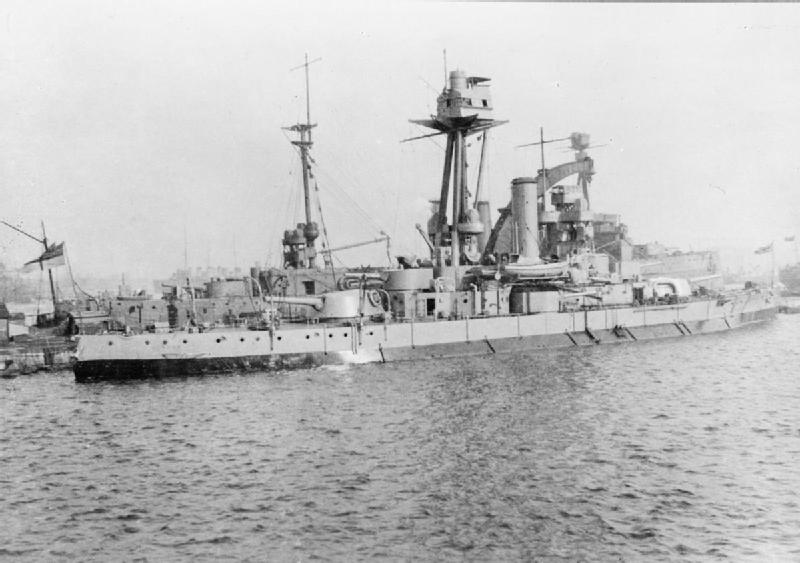
HMS Gorgon was a Royal Navy monitor constructed during World War I, originally laid down as the Norwegian coastal defense ship HNoMS Nidaros. Built by Armstrong Whitworth at Elswick, she was laid down on 11 June 1913 and launched on 9 June 1914. Her construction was significantly delayed due to extensive modifications made by the British before completion, including converting her boilers to burn both oil and coal, and adding anti-torpedo bulges along most of her hull. These features increased her displacement to approximately 5,700 long tons and reduced her top speed to 12 knots. She measured 310 feet in length with a beam of 73 feet 7 inches at maximum, and a draft of 16 feet 4 inches. Gorgon's armament comprised two 9.2-inch guns in twin turrets fore and aft, supported by four 6-inch guns in single turrets—two superfiring over the main guns and two on each side of the superstructure. She also carried smaller weapons, including one 3-inch anti-aircraft gun, four 3-pounder guns, and four 2-pounder guns. Her propulsion system consisted of two vertical triple-expansion steam engines powered by four Yarrow watertube boilers, providing a maximum speed of 12 knots. Commissioned in June 1918, HMS Gorgon participated in operations along the Belgian coast during the final months of World War I. Her first firing occurred in July 1918, targeting German batteries at long ranges, including the Batterie Pommern and Middelkerke batteries. She engaged in bombardments and reconnaissance missions, notably firing her last rounds against German coastal defenses on 15 October 1918. Her service included several attempts to neutralize German artillery positions, though with limited success due to poor visibility and lack of aircraft spotting. After the war, Gorgon was stationed in Portsmouth to assist investigations into her sister ship Glatton’s magazine explosion. She was later used as a target ship for bomb and gunfire tests, disarmed in 1922, and ultimately sold for scrap in 1928. Her service marked her as a significant, if relatively short-lived, component of Britain’s coastal and naval artillery efforts during the late stages of the First World War.
This description has been generated using GPT-4.1-NANO based on the Vessel's wikidata information and then modified by ShipIndex.org staff.