
HMS Campania
1914 seaplane tender
Vessel Wikidata
* This information from Wikidata is available under the Creative Commons Attribution-ShareAlike License
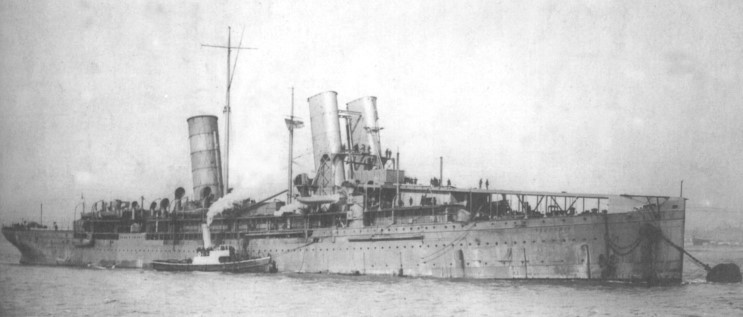
HMS Campania was a seaplane tender and aircraft carrier of the Royal Navy, converted from the aging ocean liner RMS Campania, originally built in 1893 for Cunard Line service between Liverpool and New York. The vessel measured approximately 610 feet in length with a beam of around 65 feet and was powered by machinery typical of early 20th-century ocean liners, although specific propulsion details are not provided. As RMS Campania, she was renowned for her speed, holding the Blue Riband early in her career. Purchased by the Royal Navy in November 1914 for £32,500, she was initially intended as an armed merchant cruiser but was converted by Cammell Laird into an aircraft carrier and seaplane tender. Her conversion involved removing her forward 4.7-inch guns to install a 160-foot (48.8 m) flight deck, fitted with two derricks on each side for handling seaplanes. The ship's holds were adapted to accommodate seven large seaplanes in the aft hold and four smaller ones in the forward hold, with access to the latter requiring the flight deck to be lifted. Her first takeoff occurred in August 1915 using a Sopwith Schneider floatplane. Recognizing the need for a longer flight deck, Campania was extended to 245 feet (74.7 m) between November 1915 and April 1916, enabling a broader range of aircraft operations. She carried notable aircraft such as the Short Type 184 torpedo bombers and the first aircraft designed specifically for carrier use, the Fairey Campania. Despite her innovations, she missed the Battle of Jutland in May 1916 and was later relegated to training duties due to her aging machinery. She participated in patrols and anti-submarine operations but was deemed unfit for fleet combat. On 5 November 1918, during a storm at anchor off Burntisland, Campania's anchor dragged, leading to collisions with the battleship Royal Oak and the battlecruiser Glorious. Her hull was breached, and she sank approximately five hours later, with all crew rescued. Her wreck remains a protected site, housing the remains of her aircraft and parts of her structure, serving as a significant maritime relic from World War I.
This description has been generated using GPT-4.1-NANO based on the Vessel's wikidata information and then modified by ShipIndex.org staff.