
HMS Agamemnon
1879 Ajax-class ironclad
Vessel Wikidata
* This information from Wikidata is available under the Creative Commons Attribution-ShareAlike License
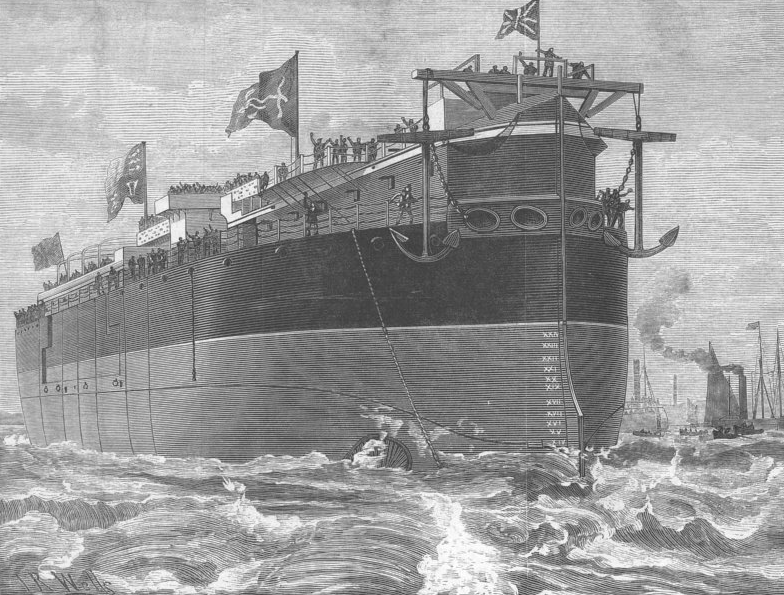
HMS Agamemnon was a Victorian-era Ajax-class ironclad turret battleship of the Royal Navy, constructed as a smaller and more economical version of the earlier Inflexible class. She was built to a design that featured a notably small length-to-beam ratio, a feature intended to enhance fuel efficiency. However, this design choice proved problematic, as it required significant helm adjustments to maintain course stability, including instances where the ship could turn in a full circle in just over nine minutes. The vessel’s armament comprised two turrets mounted in the ship’s waist, arranged in an 'en echelon' configuration. This layout was intended to allow at least two heavy guns to bear on any point of the compass, but practical firing limitations emerged. Firing along the keel line caused unacceptable blast damage to the superstructure, restricting effective fire to beam arcs. Commissioned in September 1884, HMS Agamemnon served primarily on the China Station. During her passage to the Far East, amid a Russian war scare, she notably shadowed the Russian cruiser Vladimir Monomakh. Her voyage was marred by multiple groundings in the Suez Canal, which delayed traffic for several days. In 1886, her stern was altered at Malta to address steering issues. Throughout 1889, she undertook temporary duties on the East Indies station, including participation in a blockade off Zanzibar aimed at suppressing the slave trade. During her time off Zanzibar, the crew suffered a significant outbreak of Dengue fever, with four-fifths of the crew affected but all recovering. After returning to the Mediterranean Fleet, Agamemnon remained in active service until 1892 before being placed in reserve, later joining the Fleet Reserve in 1896. She was deemed non-effective in 1901 and was officially sold for scrap in 1903. Her service history highlights her role during a period of maritime transition and reflects the evolving naval strategies of the late 19th century.
This description has been generated using GPT-4.1-NANO based on the Vessel's wikidata information and then modified by ShipIndex.org staff.