
USS Jacob Jones
1918 Wickes-class destroyer
Vessel Wikidata
* This information from Wikidata is available under the Creative Commons Attribution-ShareAlike License
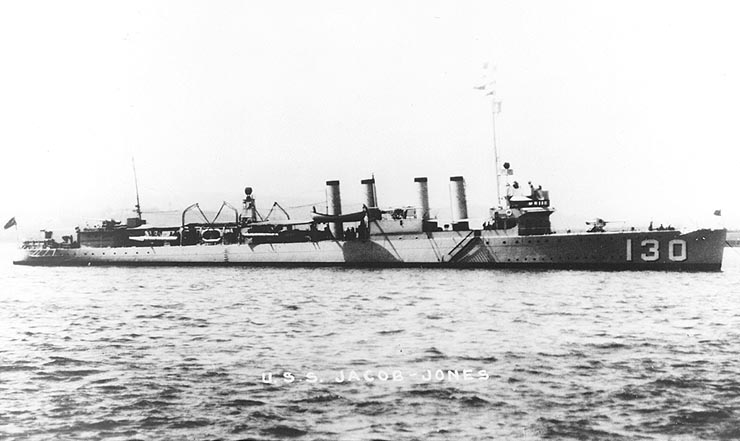
The USS Jacob Jones (DD-130) was a Wickes-class destroyer constructed by the New York Shipbuilding Corporation in Camden, New Jersey. Laid down on February 21, 1918, she was launched on November 20, 1918, and commissioned on October 20, 1919. The vessel featured the typical design of the Wickes class, which was characterized by a relatively fast speed and armament suitable for fleet escort and patrol duties of the era. After her commissioning, Jacob Jones was briefly decommissioned in June 1922 but was recommissioned in May 1930, resuming active service. Throughout the 1930s, she operated primarily along the U.S. West Coast and in the Caribbean, undertaking duties such as anti-aircraft training, fleet maneuvers, and neutrality patrols in the Atlantic. She also served as a plane guard for aircraft carriers, participated in joint Army-Navy exercises, and undertook diplomatic escort duties, notably during President Franklin D. Roosevelt's visit to Haiti in 1934. She also saw service in the Mediterranean, based in Villefranche, France, from late 1938 to early 1939, in support of American interests in Europe during the Spanish Civil War. With the outbreak of World War II, Jacob Jones was assigned to the Neutrality Patrol out of Charleston, South Carolina, in April 1940. She later transitioned to convoy escort duties along the Atlantic coast and in the North Atlantic, including operations from Newfoundland to Iceland. Her primary role was to protect Allied shipping from German U-boat threats, engaging in antisubmarine warfare (ASW) tactics such as depth charging suspected submarines. Tragically, USS Jacob Jones met her end on February 28, 1942. While patrolling off Cape May, New Jersey, she was torpedoed by the German U-boat U-578 in a nighttime attack. The torpedoes caused catastrophic explosions, destroying much of the ship and resulting in the loss of most of her crew. Only about a dozen survivors were rescued from the sinking vessel, and her loss marked the first U.S. destroyer sunk by enemy action in World War II. Her sinking underscored the perilous nature of Atlantic convoy operations and the emerging U-boat threat during the early years of the war.
This description has been generated using GPT-4.1-NANO based on the Vessel's wikidata information and then modified by ShipIndex.org staff.