
SS Amerika
Ocean Liner built for Germany by Harland and Wolff shipyards. Transferred to the United States after World War I
Vessel Wikidata
* This information from Wikidata is available under the Creative Commons Attribution-ShareAlike License
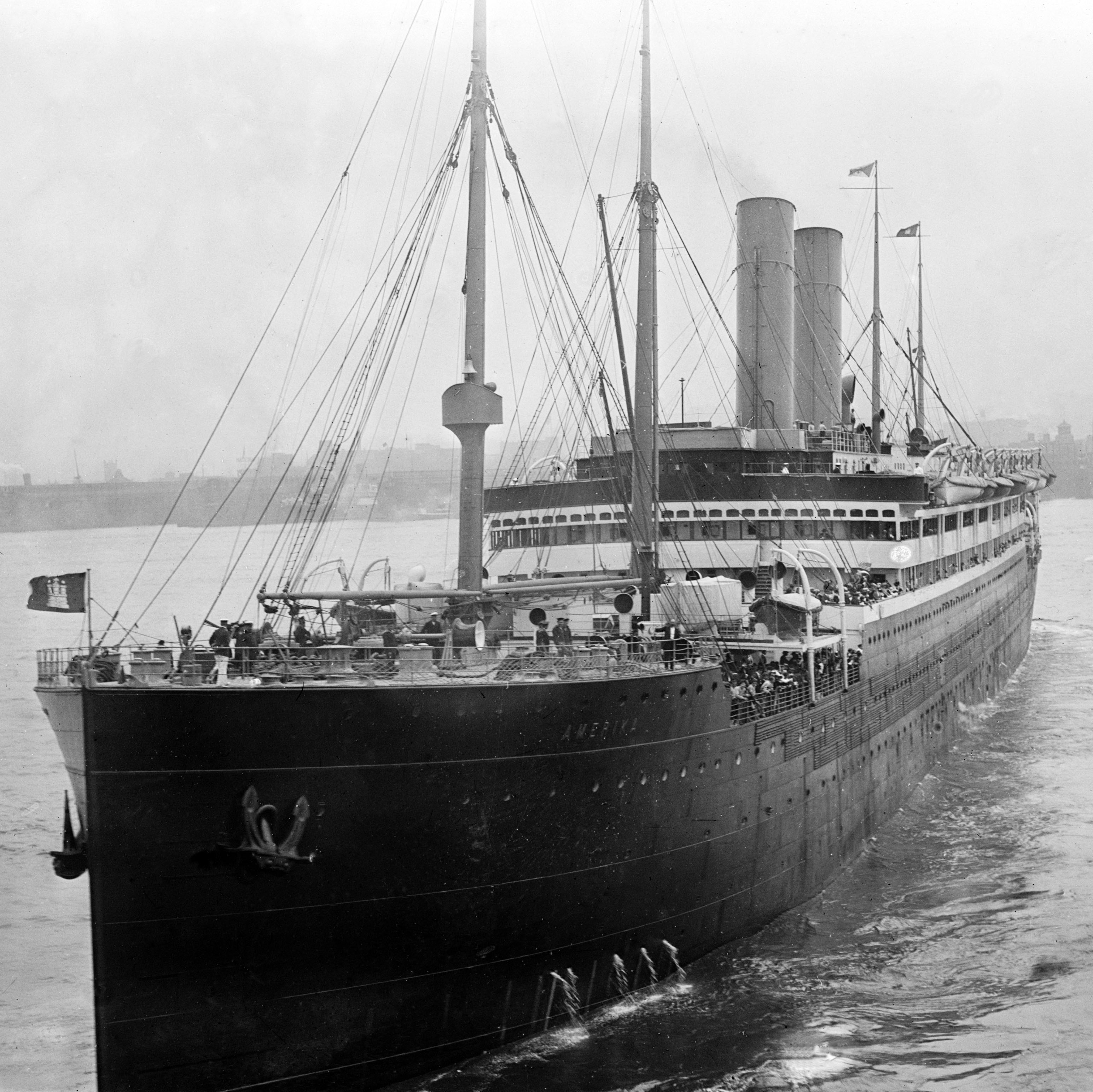
The SS Amerika, launched on 20 April 1905 by Harland & Wolff in Belfast, was a prominent transatlantic ocean liner and later a troop transport with a steel hull and a gross register tonnage of 22,225. Powered by twin screw steam engines, she was designed for luxurious passenger service, primarily operating between Hamburg, Germany, and New York City. Her interiors, crafted under the direction of French architect Charles Mewès and decorated by Waring & Gillow, exemplified opulence, featuring a grand staircase in Adam style, a Louis XVI style dining saloon, and an à la carte restaurant managed by César Ritz with menus created by Auguste Escoffier. The vessel also boasted the first electric passenger elevator, emphasizing her status as one of the most luxurious ships of her time. Her maiden voyage in October 1905 was notable, with Kaiser Wilhelm II aboard and a menu designed by Escoffier, signaling her prestige. Amerika's service included regular North Atlantic crossings, calling at Cherbourg, Boulogne, and Southampton, until the outbreak of World War I. During the war, she was docked at Boston to avoid seizure, remaining in port for nearly three years. She was seized in April 1917, transferred to the U.S. Navy, and commissioned as USS Amerika (ID-3006), soon renamed America. She was converted into a troop transport, capable of carrying nearly 40,000 troops to France, and participated actively in wartime logistics, including transporting soldiers and cargo. In 1918, America sank at her Hoboken mooring after water ingress but was raised and repaired. She resumed service, ferrying over 51,000 troops back to the U.S. after the war. Notably, she was involved in a collision with the British submarine B2 in October 1912 and a tragic incident in July 1918 when she struck the Italian steamer Florida during a storm, rescuing 32 survivors. She was decommissioned in 1919, transferred to the U.S. Army as USAT Edmund B. Alexander, and served as a troopship during World War II, including operations between New York, Europe, and the Mediterranean. After the war, she was modified to carry military dependents until she was placed in reserve and eventually scrapped in 1957. Her service history reflects her maritime significance as a luxurious liner, a vital wartime vessel, and a symbol of early 20th-century naval and passenger ship design.
This description has been generated using GPT-4.1-NANO based on the Vessel's wikidata information and then modified by ShipIndex.org staff.