
SMS Stralsund
1911 Magdeburg-class cruiser
Vessel Wikidata
* This information from Wikidata is available under the Creative Commons Attribution-ShareAlike License
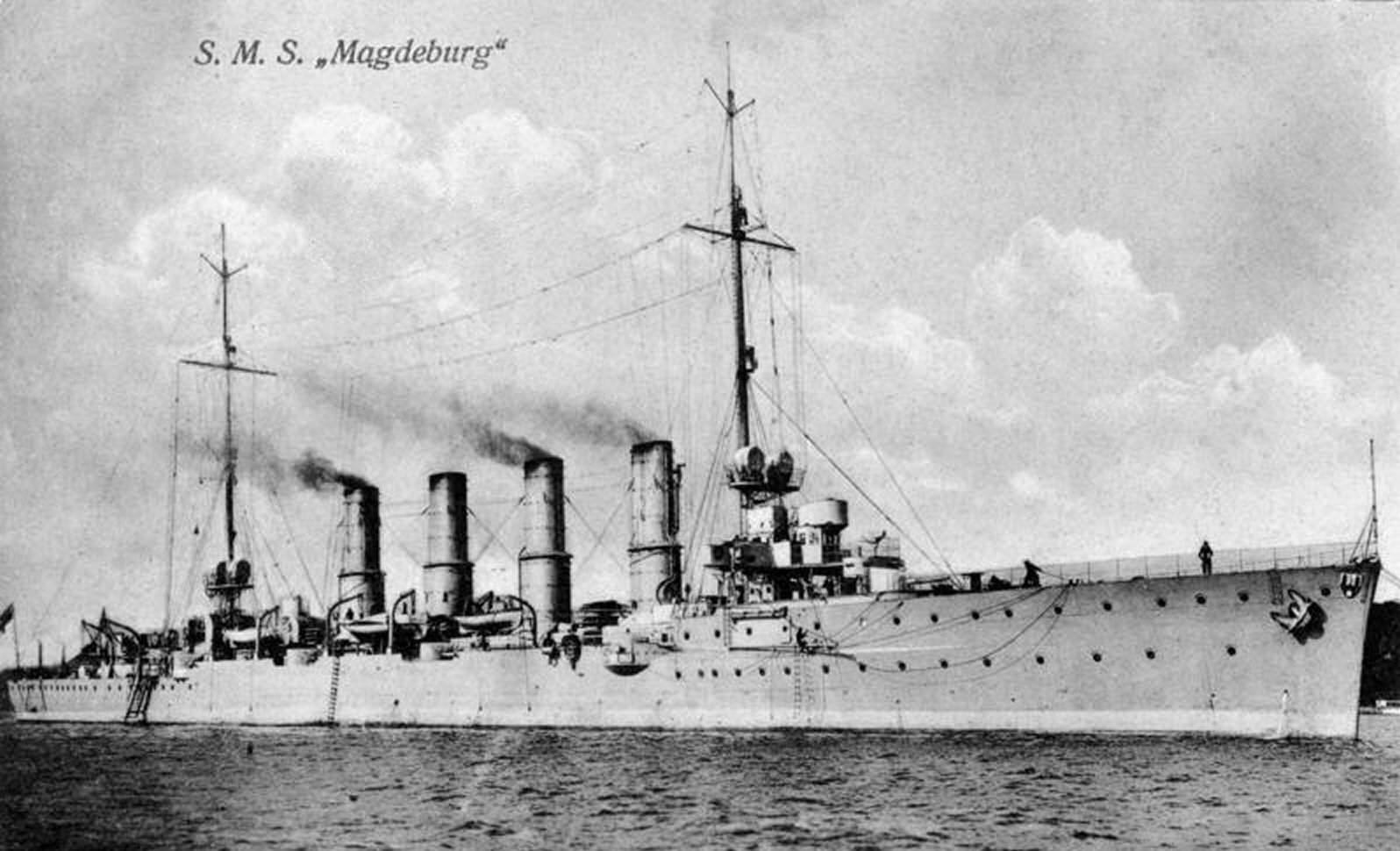
SMS Stralsund was a Magdeburg-class light cruiser of the German Kaiserliche Marine, built between 1910 and her commissioning in December 1912 at the AG Weser shipyard in Bremen. She measured approximately 138.7 meters in overall length with a beam of 13.5 meters and a draft of 4.46 meters. Displacing around 4,570 tons normally, her design featured a short forecastle deck and a minimal superstructure dominated by a conning tower. Her propulsion system consisted of three Bergmann steam turbines powered by sixteen coal-fired water-tube boilers, later converted to fuel oil, which together produced over 35,000 shaft horsepower, enabling her to reach speeds of up to 28.2 knots during trials. Armament comprised twelve 10.5 cm SK L/45 guns, with a maximum range of approximately 12,700 meters, and two submerged 50 cm torpedo tubes with five torpedoes. She also carried up to 120 mines. The ship’s armor included a 60 mm waterline belt and deck, with her conning tower protected by 100 mm of armor. Her crew numbered 18 officers and 336 enlisted men. In her service, SMS Stralsund was primarily tasked with reconnaissance duties for the High Seas Fleet. She participated actively in early World War I operations, including reconnaissance sweeps and engagement in notable battles such as the Battle of Heligoland Bight in August 1914, where she actively engaged British destroyers and helped rescue crew from the damaged cruiser Ariadne. She also took part in the Battle of Dogger Bank in January 1915 and in raids on the English coast, including the bombardments of Scarborough, Hartlepool, and Whitby in December 1914. Throughout the war, she conducted mine-laying operations, patrols, and supported fleet actions, occasionally coming under attack from British submarines and aircraft. Notably, SMS Stralsund missed the Battle of Jutland, being in dockyard hands at the time of the engagement. She was refitted in mid-1916, replacing her guns with larger 15 cm and 8.8 cm guns and extending her forecastle for improved combat capability. She served as a flagship for various scouting groups, participated in fleet operations in the Baltic and North Sea, and was involved in the Operation Albion in the Gulf of Riga. After the war, she was surrendered and transferred to France, where she was renamed Mulhouse. She served in the French Navy until 1933, participating in the Mediterranean and Atlantic fleets, before being decommissioned and broken up by 1935. The vessel's history highlights her role as a fast, lightly armored cruiser integral to German naval reconnaissance and fleet operations during World War I.
This description has been generated using GPT-4.1-NANO based on the Vessel's wikidata information and then modified by ShipIndex.org staff.