
HMS Unicorn
1824 Leda-class fifth-rate frigate
Vessel Wikidata
* This information from Wikidata is available under the Creative Commons Attribution-ShareAlike License
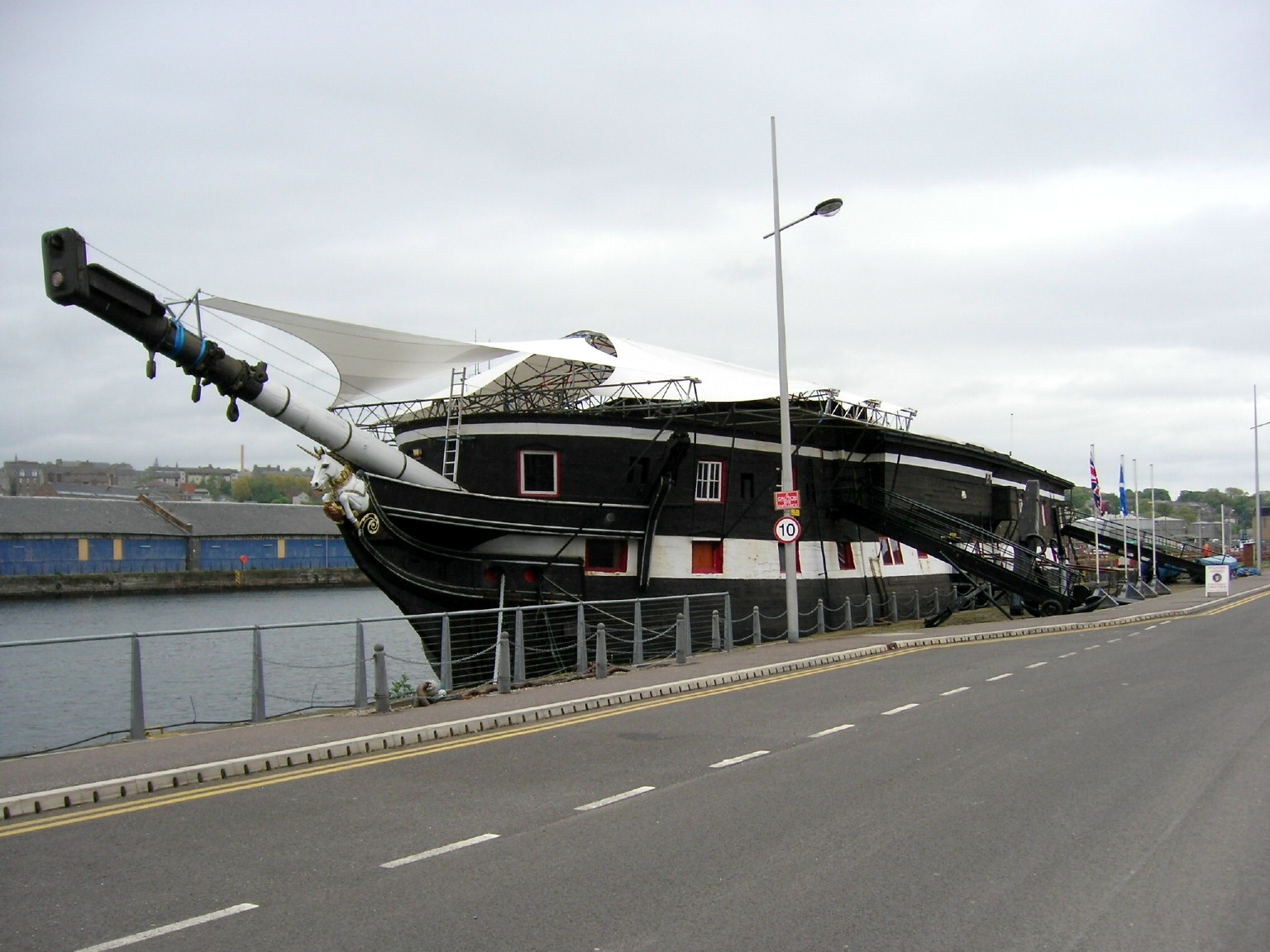
HMS Unicorn is a preserved sailing frigate of the Leda class, built during peacetime at Chatham Dockyard in 1824. As a product of a transitional period in shipbuilding, she features a modified design that includes a circular stern and a "small-timber" construction system. Her construction was overseen by Sir Robert Seppings, who incorporated iron straps and iron "knees" to reinforce her hull, reflecting the evolving use of materials as timber became scarcer and iron more available. Unicorn measures approximately 46 meters (151 feet) in length and was originally rigged as a sailing warship, although she was never fitted with sails due to her post-war construction. Instead, a superstructure was added over her main deck, and she was laid up "in ordinary" for most of her service life, serving as a hulk and depot ship. Her only sea voyage occurred in 1873 when she was towed by HMS Salamander to Dundee to serve as a drill ship for the Royal Naval Reserve, replacing HMS Brilliant. Throughout her long history, Unicorn has served various roles, including a floating gunpowder store, a reserve drill ship, and a training center for the Women's Royal Naval Service during World War II, where she notably accepted the surrender of German U-boat U-2326 in 1945. She was renamed HMS Cressy during the war to avoid confusion with a newer aircraft carrier and later reverted to her original name. Today, HMS Unicorn is recognized as a significant maritime artifact, being the oldest ship in Scotland and one of the oldest warships still afloat worldwide. She is preserved as part of the National Historic Fleet and functions as a museum ship in Dundee. Her remarkably intact condition, with around 90% of her original fabric preserved, makes her one of the most original ships of her era. Ongoing restoration efforts, supported by substantial funding, aim to ensure her preservation for future generations and her role as a maritime heritage centerpiece.
This description has been generated using GPT-4.1-NANO based on the Vessel's wikidata information and then modified by ShipIndex.org staff.